



















Feature flags can make a casino game release smaller and easier to reverse, but they cannot turn an unreviewed behavior into an approved one. The safe pattern is to classify the change first, keep fairness-critical behavior outside ordinary product toggles, constrain evaluation to approved cohorts and retain enough versioned evidence to reconstruct what each build displayed.
Requirements depend on where the game is supplied. For Great Britain, the Gambling Commission’s testing procedure distinguishes updates that may affect game fairness from minor updates and requires relevant new games and fairness-affecting changes to receive external testing before release. Other jurisdictions and laboratories have their own rules, so a flag service is an implementation tool, not a universal approval mechanism.

Classify the change before creating a flag
Every proposed toggle should have an owner, purpose, affected components and a written classification. Ask whether either variant can change outcome determination, probability, paytable behavior, stake or balance handling, required player information, interruption recovery or other reviewed behavior.
If the answer may be yes, stop treating the work as an ordinary rollout flag. Route it through the compliance, test-lab and operator process that applies to the target market. The UK Gambling Commission’s Annex A defines a major update as a software change that may affect game fairness; it does not say that putting the change behind a switch makes it minor.
Lower-risk candidates can include telemetry exporters, non-material performance paths, staged asset delivery or a reversible interface change, but only after review confirms that both states preserve the tested product obligations. The classification and reviewer belong in the flag record.
Bind every variant to an immutable build contract
A flag should select among behaviors already present in a named application build. Record which build first introduced the flag, the complete set of variants and the configuration versions approved for each environment. Do not use a mutable remote value to smuggle arbitrary data or scripts into a certified client.
Keep the evaluation type narrow. A boolean or small enumerated variant is easier to validate than a free-form object that can rewrite layout, timings or rules. Reject unknown variants and fall back to a reviewed default.
The default must work when the provider is unavailable at startup, disconnects during play or returns stale data. Cache rules need an expiry and a defined behavior; silently retaining an old configuration forever makes incident reconstruction unreliable.
Make targeting minimal and deterministic
The OpenFeature specification defines an evaluation context that can carry a targeting key and custom fields for rule or fractional evaluation. That flexibility should be constrained for casino releases. Use only the smallest approved set of stable attributes, such as environment, operator integration, build or a predeclared rollout cohort.
Avoid copying player profiles, balances or wagering history into the flag system. Percentage rollouts need a stable key to keep the same subject in one cohort, but the key can be pseudonymous and scoped. Privacy, equal-treatment and product rules determine whether player-level targeting is appropriate at all.
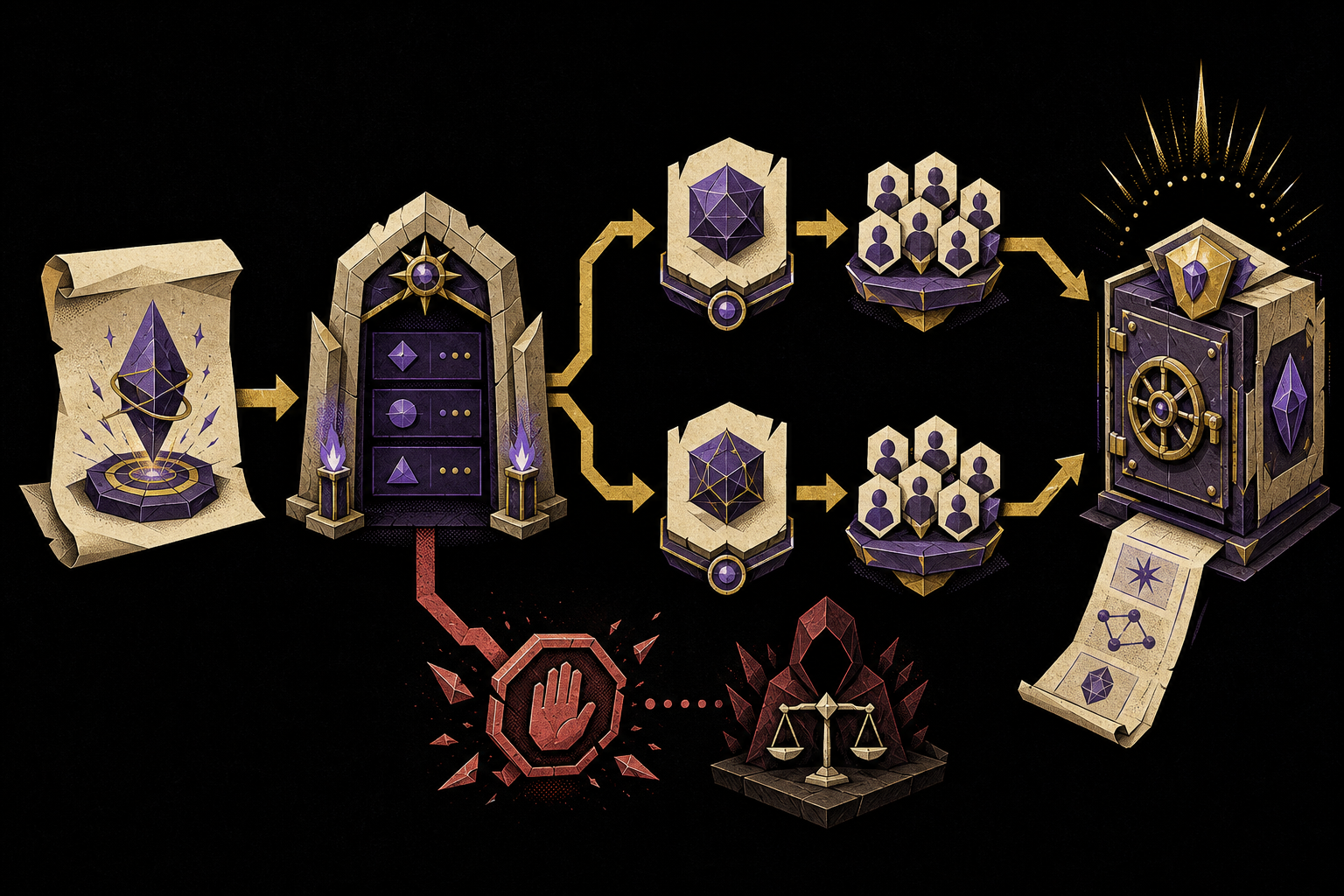
Evaluate at a stable boundary. Changing a presentation flag between sessions may be acceptable; changing a behavior halfway through a round can produce an untestable combination. Snapshot the relevant configuration at session or round creation when consistency requires it, and record the snapshot version.
Preserve an audit trail without collecting excess data
For each material evaluation, retain the flag key, selected variant, reason, configuration version, application build, environment and approved cohort needed to reconstruct behavior. OpenFeature’s flag evaluation API defines evaluation details including flag key, variant and reason, giving implementations a consistent shape for part of that record.
Do not turn auditability into unrestricted event collection. A configuration ledger can record every change once, while aggregate metrics show rollout health and selected domain events link a round to the configuration snapshot when operationally necessary. Define retention and access with compliance and privacy owners.
Separate duties for sensitive flags. The person who writes a fairness-adjacent change should not be the only person able to approve its configuration and erase its history. Production changes need authentication, authorization, immutable history and a tested emergency path.
Test both states, failure states and transitions
Every supported variant is production code. CI should test the default and non-default states, while integration tests simulate provider timeout, invalid type, unknown variant and stale cache. A rollback test must prove that the system returns to a complete known state, not merely that the dashboard switch changes color.
Run negative tests around the classification boundary. Attempt to place a prohibited fairness-critical value in ordinary configuration and confirm the schema or policy blocks it. Remove provider connectivity and confirm the reviewed default loads. Change configuration during a test round and confirm snapshot rules prevent a mixed state.

Monitor rollout results by approved cohort and version. The RGS observability model provides a way to connect aggregate symptoms to configuration evidence without making player IDs into metric labels.
Retire flags as part of the rollout
Temporary flags need an owner and removal condition when they are created. After a rollout is complete, remove the inactive branch and provider rule while preserving the evidence required by the release and market process. Otherwise each stale flag doubles part of the behavior space that engineers, testers and incident responders must reason about.
For certification and compliance, the valuable property is not the presence of a feature-flag product. It is the explicit connection among source, build, approved variants, configuration history, observed rollout and rollback behavior.
A controlled flag can reduce blast radius. It cannot reduce the meaning of the change it controls.
Frequently asked questions
Can certified casino games use feature flags?
Feature flags can support controlled delivery, but they do not bypass testing, approval or change-classification requirements. The permitted use depends on the jurisdiction, laboratory, operator controls and whether the flag can affect game fairness or required information.
What should never be an ordinary runtime flag?
A value that can alter outcome determination, paytable logic, stake accounting or other fairness-critical behavior should not be treated as an ordinary product toggle. It requires the change control and testing applicable to that product and jurisdiction.
What is a safe default for a casino game flag?
The safe default is the reviewed behavior that preserves a complete and compliant game when the flag provider is unavailable, slow or returns an invalid value. The fallback must be explicit and tested.
Should feature flags target individual players?
Avoid individual-player targeting unless there is a documented, approved need. Cohorts should use minimal stable attributes, preserve equal treatment rules and avoid unnecessary personal data in the evaluation context.
What belongs in a feature flag audit record?
Record the flag key, evaluated variant, reason, configuration version, application build, environment, approved cohort and timing needed to reconstruct behavior. Protect the record from unnecessary personal or wagering data.
When should a feature flag be removed?
Remove a temporary flag after rollout or rollback is complete and evidence retention requirements are met. Permanent stale branches increase the number of behaviors that testing and incident response must understand.