






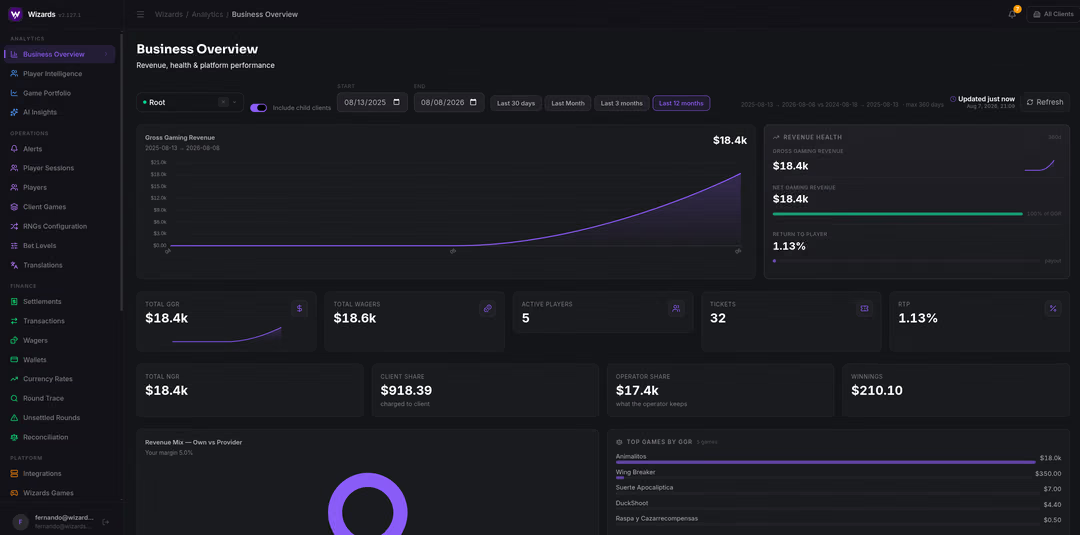
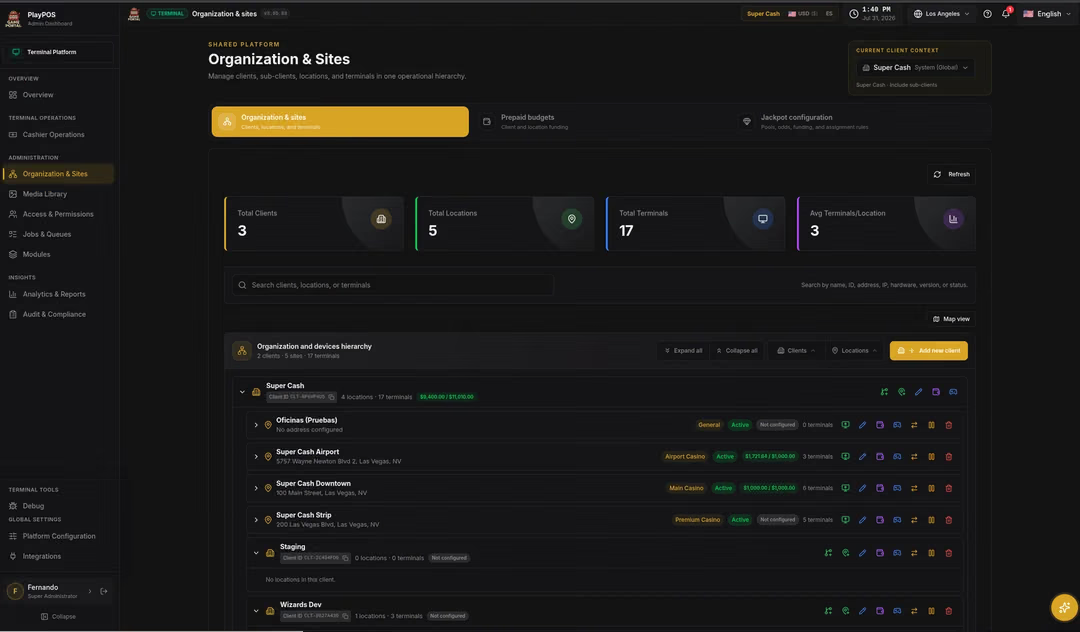











iGaming back-office access control should decide every sensitive action from verified identity, current context and explicit authority, then leave evidence that another reviewer can test. A menu hidden from one role is not a control if the underlying API still accepts the command, and a broad administrator account is not an operating model.
For an operator CTO, platform owner, security lead, compliance owner or procurement buyer, the decision is how staff and suppliers may inspect or change player, wallet, game, bonus, payment, risk and configuration state. The useful delivery artifact is a versioned back-office authorization pack that joins an action inventory, role and attribute matrix, approval rules, privileged-session controls, audit events, exception paths and acceptance tests.

Inventory sensitive actions before naming roles
An iGaming back office needs an action inventory before it needs role names. List what a person or service can view, create, approve, change, export, suspend, reverse, publish or delete, and identify the authoritative system behind each command.
Start with player identity and restrictions, wallet and transaction state, withdrawals, manual adjustments, bonuses, game and market configuration, jackpots, content publication, risk decisions, support notes, personal-data exports, credentials and system settings. Record whether each action is read-only, value-bearing, player-affecting, security-sensitive or release-sensitive. A permission called manage players hides too many different consequences to test.
Great Britain’s remote gambling security requirements identify access control, identity management, authentication information, access rights, privileged rights, information restriction, logging and clock synchronization among the applicable control areas for critical systems. That is jurisdiction-specific scope, not a universal role catalogue. It still supports the procurement principle: the platform must expose its sensitive actions clearly enough to apply and evidence the required controls.
Derive authorization from duties and context
Back-office authorization should use job duties as one input rather than treating a job title as permanent authority. A support agent, finance reviewer, fraud analyst, game operator and release engineer may all need access to the same player or transaction, but they do not need the same fields or commands.
Build the matrix across subject, action, resource and context. Subject fields can include workforce identity, employer, team, training status and current assignment. Resource fields can include brand, tenant, jurisdiction, product, currency, player segment and data classification. Context can include device trust, location, time, incident state and whether a fresh approval exists. Keep the policy understandable enough that operations can explain why one request was allowed and another was denied.
The OWASP Authorization Cheat Sheet recommends least privilege, deny by default and permission validation on every request. It also explains why role-only models can be too coarse for object-level and contextual decisions. Apply those principles at the trusted service boundary. The browser may hide unavailable actions for clarity, but the API must make the authorization decision again from trusted identity and resource data.
Separate initiation approval and review
Sensitive back-office changes should separate the person who proposes an action from the person who approves or reviews it when the risk warrants that control. The exact split depends on the action and applicable requirements, but one account should not silently create, approve and erase the evidence for a value-bearing correction.
GLI-19 Interactive Gaming Systems Version 3.0 includes access controls and segregation of duties in its employee-management baseline. It also says alteration of accounting, reporting or significant-event data should use supervised access controls and record the alteration identifier, before and after values, time and user. GLI is a technical reference that jurisdictions may adopt or adapt, not proof that one approval workflow satisfies every market.
Define which actions need a second approver, which need an independent post-action review and which may execute immediately under a lower-risk role. A maker-checker flow should bind the approver to the exact proposed value and reason. If the amount, player, destination, rule version or evidence changes, the approval should no longer authorize the new command.

Make privileged sessions short scoped and attributable
Privileged access should be a temporary, scoped session rather than a second everyday identity with permanent power. Require strong authentication, limit the session to the named task and resource set, and end it when the approval, incident or support window closes.
NIST SP 800-53 Revision 5 provides cross-industry control families for account management, separation of duties, least privilege, identification, authentication and audit. Use those controls as design inputs, then map them to the platform’s actual risks and the governing authority. Do not claim that referencing NIST makes the product certified or compliant.
Define step-up authentication for actions whose consequence is greater than ordinary navigation. Record the original workforce identity even when a privileged broker issues the session. Avoid shared support or root accounts. Where an emergency account is unavoidable, store it securely, alert on use, constrain its capabilities and require a documented review that cannot be completed by the same user.
Session recording can help with high-risk administrative work, but it can also capture personal data, secrets or payment information. Specify which commands and metadata are necessary, how sensitive values are redacted, who may view the record and when it is deleted. More surveillance is not automatically better evidence.
Keep supplier support inside the same boundary
Supplier support access should follow the same identity, scope, approval and evidence model as workforce access. A vendor tunnel or support console must not become an unreviewed route around tenant, brand, market or data restrictions.
The Gambling Commission’s security requirements include supplier relationships, ICT supply-chain controls and monitoring of supplier services within their stated scope. GLI-19 likewise says access rights should be removed when employment, contracts or agreements end, or adjusted when duties change. Translate those principles into contract fields: named support organization, individual identity, permitted systems, permitted actions, request and approval route, access window, monitoring, evidence return, offboarding and incident revocation.
Do not issue a standing shared credential because support might need it later. Test the activation path before launch, including an expired approval, a disabled supplier user, an attempt to cross tenant scope and immediate revocation during an incident. The multi-tenant platform isolation guide covers the deeper resource boundary; supplier access must preserve it rather than creating a global operator shortcut.
Design audit events for decisions not screenshots
Back-office audit evidence should reconstruct who attempted what, against which resource, under which policy and approval, with what result. Screenshots and generic activity labels cannot prove the command accepted by the authoritative service.
For each sensitive attempt, record a stable event identifier, trusted actor identity, acting organization, role or policy version, resource identifiers, action, decision, reason category, approval reference where applicable, timestamp, request correlation, outcome and resulting authoritative reference. Protect the log from ordinary back-office alteration and restrict its contents so the evidence does not become another uncontrolled copy of player data.
OWASP treats logging as a detective and investigation control and warns that both too little and too much logging can be harmful. GLI-19 calls for logs on critical components to be protected from tampering and unauthorized access and reviewed through a documented process. Synchronize clocks and preserve enough correlation to order an approval, command and result across services without pretending timestamps alone prove causality.
The penetration testing requirements guide explains how an authorized test can challenge role boundaries. The authorization pack defines the expected decisions first, so testing can compare both allowed and forbidden behavior against an explicit contract.
Test access as a matrix of allowed and forbidden behavior
Back-office acceptance testing should prove both that permitted work remains possible and that nearby unauthorized paths fail safely. Create test identities for every material role, tenant, market and support boundary, then exercise the same commands through the interface and the underlying APIs.
Test missing identity, stale membership, disabled users, wrong tenant, wrong jurisdiction, guessed resource identifiers, direct API calls, changed approval payloads, duplicate submissions, expired step-up sessions, concurrent role changes, supplier offboarding, emergency access and log failure. Verify that a rejected action creates no partial change and that an approved retry does not duplicate a value-bearing effect.

Bind the tests to an exact build, policy version and role catalogue. Preserve failures and known exceptions with an owner and review date. A role matrix that passes only its happy paths can still permit horizontal access across players, tenants or brands, while a policy that blocks normal support work will invite unsafe workarounds.
The final acceptance pack should contain the sensitive-action inventory, data and resource classifications, identity sources, authorization matrix, policy versions, approval rules, privileged-session design, supplier-access contract, emergency path, audit-event schema, test cases, results, exceptions and exact release identity. It does not guarantee that misuse is impossible. It gives delivery and procurement teams a versioned answer to who can do what, under which conditions, and how that answer was verified.
For operators commissioning or replacing the administrative systems behind casino and sportsbook products, Wizards platform development can turn this authorization pack into scoped platform, API and acceptance requirements.
Frequently asked questions
What should an iGaming back-office access matrix include?
It should map each trusted identity to specific actions, resources and conditions, including tenant, brand, market, data class, approval, session and supplier boundaries. It should also identify the policy version and required audit evidence.
Is hiding a back-office button an access control?
No. Hiding unavailable actions can improve the interface, but the trusted API must validate authorization on every request using server-held identity, resource and policy data.
Which back-office actions need two-person approval?
The answer depends on risk and applicable requirements. Value-bearing corrections, sensitive configuration changes and exceptional access are common candidates, but the operator must define the exact action, approver independence and invalidation rules.
How should supplier support access an iGaming platform?
Supplier access should use named identities, an approved scope and time window, strong authentication, monitoring and immediate revocation. It should preserve tenant and data boundaries and leave evidence tied to the support request.
What should a privileged back-office audit event record?
It should record the trusted actor, organization, action, resource, policy and approval references, timestamp, decision, outcome and correlation identifiers while avoiding unnecessary sensitive data.
How do buyers test back-office access control before launch?
They should test allowed and forbidden behavior through both the interface and APIs using representative roles, tenants, markets, approvals, expired sessions, supplier users and emergency paths, all bound to the exact release and policy version.