







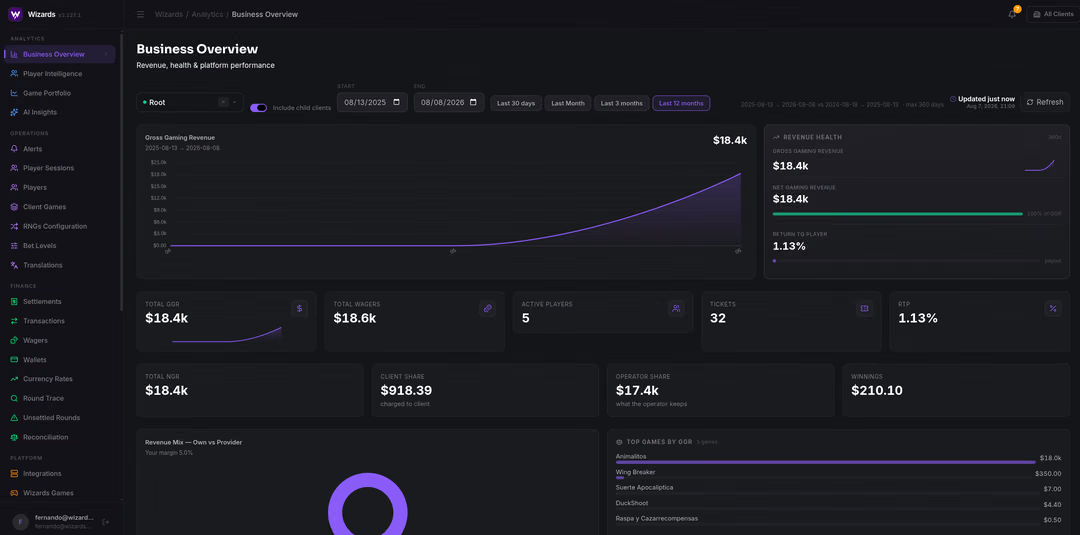
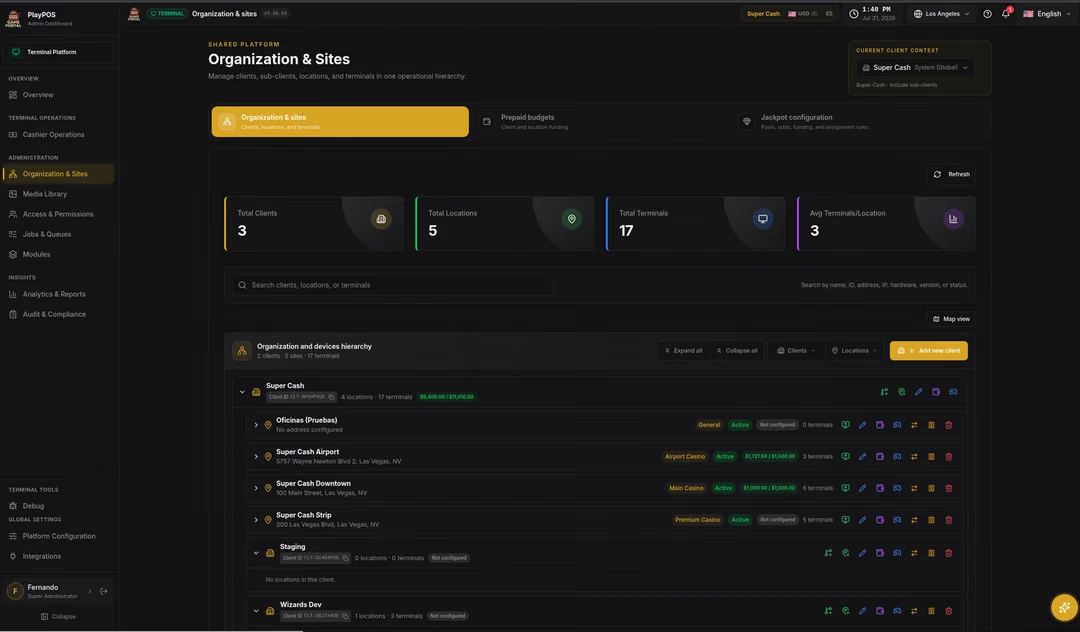












An iGaming non-production environment should be commissioned as a controlled release system, not as a cheaper copy of production. The useful delivery artifact is a versioned environment control specification that states what must match production, what must remain isolated, which differences are accepted and which evidence can authorize a release.
For an operator, platform provider, RGS provider or studio, the decision is not simply whether to buy a development, test or staging environment. The decision is how those environments will prove a game, platform or player-facing app against the intended live configuration without exposing live player data or creating an uncontrolled path into production.

Define the release question before choosing environments
The environment design should begin with the release question because a generic staging tier cannot prove every product risk. Name the product, market, channel, critical systems, release artifact and decision owner before selecting topology or tooling.
Map the path from source and configuration through build, deployment, integration, acceptance and production. For each step, record who may change it, which identity performs the change, which evidence is retained and which approval moves the artifact forward. A game content update, wallet change, geolocation integration and native app release do not need identical test systems, but each needs an environment capable of reproducing its material behavior.
The UK Gambling Commission guidance on in-house developing, testing and release describes logically separate development and test facilities, documented change plans, adequate testing, change control and authorization before migration into operation. That is jurisdiction-specific guidance, not a universal architecture. It still gives a buyer a useful starting question: which controlled environment produces the evidence for each release decision?
Turn the answer into an environment inventory. Include development workspaces, build and artifact services, automated test tiers, integration environments, user acceptance or staging, security test facilities and production verification. A named tier without an owner, baseline and evidence purpose is only a label.
Separate production without making testing artificial
Non-production environments should be separated from production while still reproducing the constraints that matter to the release. Isolation protects operational systems; fidelity makes the test result relevant.
The Commission’s remote technical standard security requirements incorporate controls for security testing during development and acceptance, separation of development, test and production, change management, test information and network segregation within their stated scope. NIST’s Secure Software Development Framework is not gambling-specific, but its PO.5.1 practice similarly calls for each development, build, test and distribution environment to be separated and protected, including through segmentation and access controls.
Define trust boundaries rather than relying on environment names. Production credentials must not work in test. Test identities must not authorize production changes. Build services should publish identified artifacts through a controlled promotion path instead of rebuilding untraceable variants in every tier. Administrative access, secrets, signing keys, outbound network routes and supplier connections need explicit policies.
Separation does not mean a harmless mock can stand in for every difficult dependency. The test tier must still reproduce production protocols, configuration rules, timeouts, retry behavior, capacity constraints and failure responses when those properties affect the decision. If a substitute service behaves differently, record the difference and run a separate integration test against a representative endpoint.
Make production parity an explicit difference register
Production parity should be measured as a declared set of release-relevant similarities and differences, not claimed as a vague property of staging. No non-production system is perfectly identical to live operation, so the buyer needs to know which gaps matter.
Create a baseline for operating system and runtime versions, infrastructure topology, application and game artifacts, feature flags, market configuration, identity roles, network policy, data schemas, queues, caches, external services, observability and recovery controls. Compare that baseline with the intended production target for every release candidate. Each difference receives an owner, reason, affected test, mitigation and expiry condition.
GLI-19 Version 3.0 describes a production-equivalent environment for testing and says patches should be tested in a development or test environment configured identically to the target production environment whenever possible. It also requires production to be logically and physically separated from development and test within its scope. GLI-19 is a technical standard and procurement reference, not a universal certification promise.

Parity is therefore a risk statement. A smaller test database may be acceptable for a functional rule check but inadequate for a migration timing test. A payment simulator may prove request validation but not a live provider timeout. Record both conclusions instead of giving the entire environment one pass label.
Keep live player data and credentials outside the test boundary
Test data should reproduce the necessary shapes and edge cases without copying uncontrolled live player records into non-production systems. Data safety includes logs, backups, exports and supplier tools, not only the main database.
GLI-19 states within its scope that actual personally identifiable information and raw production data should not be used in development and test. Define a test-data policy that names approved synthetic, generated, tokenized or otherwise transformed sources; permitted fields; retention; access; disposal; and the person who approves an exception. Do not assume masking is safe until re-identification risk and linked datasets have been considered under the applicable rules.
Seed scenarios for identity states, wallet balances, currencies, jurisdictions, limits, exclusions, interrupted rounds, payment outcomes and historical migrations. The objective is deterministic coverage, not realism created by importing an uncontrolled production snapshot. Test fixtures should be versioned with the release evidence so another reviewer can reproduce the result.
Credentials need the same discipline. Use non-production keys with narrower access, separate secrets stores and visible expiry. Verify that monitoring agents, support tools, analytics collectors and third-party callbacks do not quietly cross the boundary or send test events into live customer workflows.
Rehearse integrations failure and recovery
The staging environment should reproduce every integration and recovery behavior that can change the release decision. A successful happy path does not prove what happens when a trusted service is slow, unavailable or inconsistent.
Inventory identity, PAM, wallet, payments, geolocation, RGS or game services, bonus systems, messaging, content delivery, monitoring and regulatory reporting connections as applicable. For each dependency, choose a real non-production endpoint, controlled simulator or fault proxy, then state what that choice cannot prove. Bind endpoint version, credentials class and configuration to the environment baseline.
The Commission’s procedure for testing says testing should use the software and environment intended for live use and calls for additional integration testing where differences can affect the original testing in its Great Britain framework. It also describes representative retesting when relevant RGS or RNG changes may affect games, with the scope decided by the licensee and approved test house.
Test unavailable dependencies, slow responses, duplicate and out-of-order messages, expired identities, partial deployment, rollback, restart, recovery from backup and synchronization after reconnection. GLI-19 also calls for linked components to be tested after installation and before production, including restart, recovery and synchronization. The RGS integration requirements guide provides the deeper command and round-state contract for casino game connections.

Bind release evidence to the exact environment
Release evidence should identify the artifact, configuration, data set and environment that produced it. A test report without those identities can describe a result but cannot prove the launch candidate passed.
Create a release pack with artifact digests, source and dependency versions, deployment manifest, environment baseline, difference register, test-data version, integration endpoints, positive and negative results, security findings, recovery evidence, unresolved exceptions and named approvals. Add applicable laboratory or authority records without presenting one jurisdiction’s route as universal.
Define invalidation rules before testing. A material artifact, configuration, dependency, environment or data-fixture change should identify which results must be rerun. The buyer should also require a limited production verification plan that checks the deployed identity and critical connections without treating live players as test subjects.
This is the distinction from a general release checklist: the environment itself becomes a controlled part of the evidence chain. For teams commissioning iGaming platform development, the environment control specification should be agreed with the platform architecture, supplier boundaries and acceptance plan before build work makes those choices expensive to change.
Frequently asked questions
What should an iGaming test environment reproduce from production?
An iGaming test environment should reproduce the release-relevant configuration, interfaces, access rules, dependencies, observability and failure behavior of the intended production target. Every known difference should be recorded with its test consequence.
Should development test and production environments be separate?
Development, test and production should be logically separated, with access controls and change paths appropriate to each environment. The exact topology depends on the product and applicable requirements, but convenience should not create an uncontrolled route into production.
Can production player data be used in an iGaming test environment?
Teams should keep actual production player data and live credentials out of non-production environments. Use synthetic or properly transformed test data under a documented policy, and verify that logs, backups and supplier tools follow the same boundary.
How should configuration drift be tested?
Configuration drift should be tested by comparing a declared production baseline with the exact non-production release candidate, recording every difference and proving whether each difference changes behavior, security, fairness, recovery or evidence.
What third-party services should an iGaming staging environment include?
An iGaming staging environment should represent every third-party dependency that can change the release decision, such as identity, wallet, payments, geolocation, game or RGS services, content delivery and monitoring. Controlled substitutes are acceptable only when their limitations are explicit and separately tested.
What evidence should a buyer require before an iGaming release?
A buyer should require the exact artifact and configuration identities, environment baseline, difference register, data controls, integration and failure results, unresolved exceptions, approvals and any applicable test-house or authority records.
If you are commissioning an iGaming platform, talk to Wizards about defining the environment boundaries, parity rules and release evidence as one testable delivery contract.