
















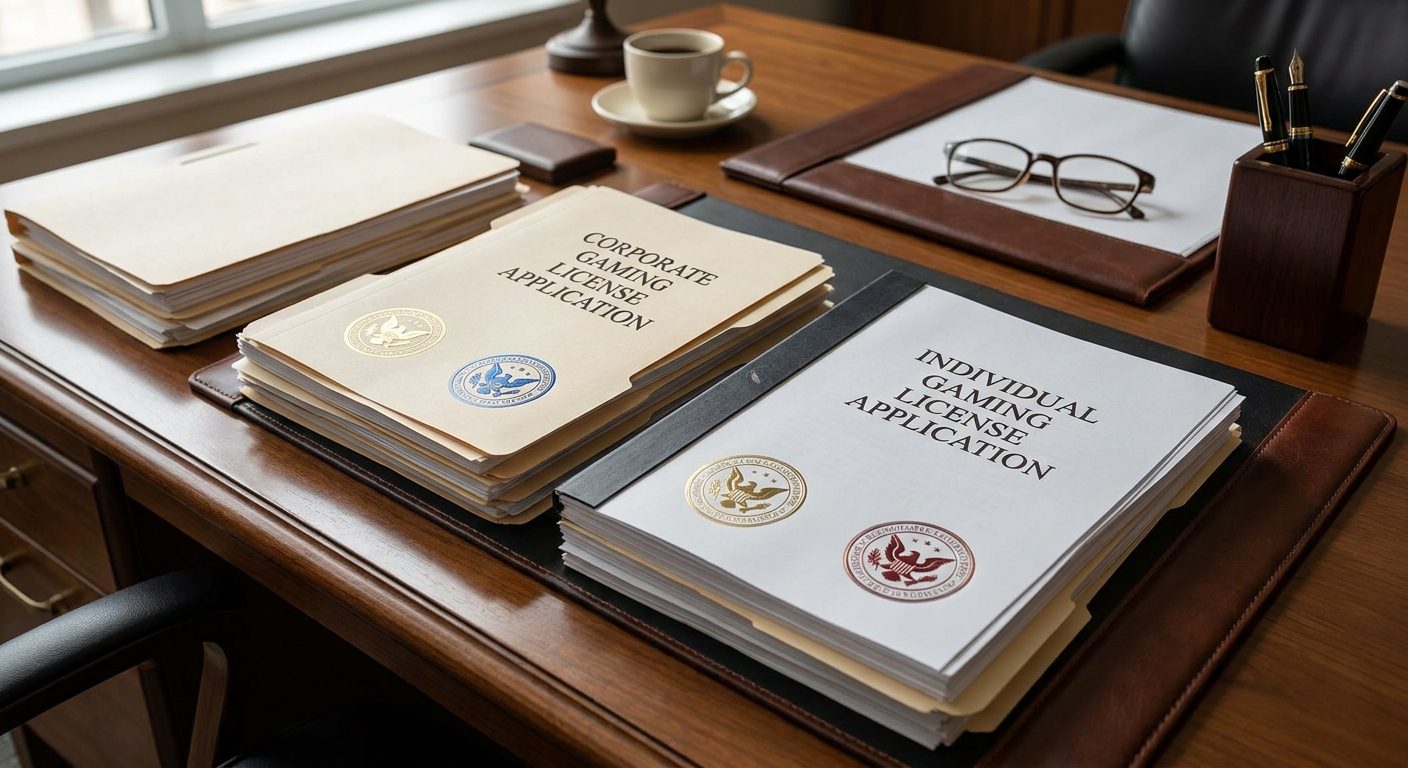

Nevada’s gaming framework draws a sharp line between the company that runs a gaming business and the people inside it. Anyone researching a nevada gaming license quickly finds that “the license” is really three different authorizations, each with its own process.
Knowing which one applies to you, the operating entity, a key owner, or a floor employee, is what prevents costly delays. Preparing the corporate side often calls for specialized gambling certification services.

The three layers of Nevada gaming authorization
Nevada maintains some of the strictest suitability standards in the world, vetting both businesses and the individuals tied to them. In practice, that means three distinct routes, summarized below.
| Aspect | Operating company | Key individuals (owners and executives) | Gaming employees (staff) |
|---|---|---|---|
| Authorization | Nonrestricted or restricted license | Finding of suitability or individual license | Gaming Employee Registration (the “work card”) |
| Applies to | The legal entity operating gaming | Officers, directors, and significant owners | Dealers, cashiers, supervisors, surveillance |
| Main focus | Corporate finances, ownership, controls | Personal finances, character, criminal history | Criminal background via fingerprints |
| Typical timeline | Several months to a year or more | Six to twelve months | Days to a few weeks, employer-initiated |
| Cost | Investigation fees billed to applicant | Investigation costs billed to applicant | $50 registration fee (since June 2025) |
What operators must demonstrate
The Nevada Gaming Control Board (NGCB) reviews the operating entity in depth. The core areas are:
- Corporate structure and ownership — full disclosure of parent companies, subsidiaries, and beneficial owners.
- Financial standing — Nevada does not publish a fixed minimum. The NGCB assesses whether your financing is adequate for the specific operation, so a small card room and a major Strip property face very different expectations.
- Source of funds — all capital must trace to legitimate, documented sources.
- Business plan and controls — proposed operations, internal controls, and responsible gaming measures.
The NGCB separates restricted licenses, for venues with 15 or fewer slot machines and no other games, from nonrestricted licenses for full casinos. A narrow interactive gaming license also exists, but under Assembly Bill 114 (2013) Nevada authorizes only online poker, not online casino or slots, and only a couple of operators currently hold one.
Meeting the technical side of these requirements often means working with experienced gambling platform providers who understand Nevada’s compliance expectations.

What key individuals must clear
Owners and executives who control or significantly influence a gaming business undergo their own background investigations, separate from the company’s application.
- Who qualifies — officers, directors, and significant owners (for publicly traded entities, the threshold often starts around 5% and varies by structure), plus employees with real management discretion.
- Personal disclosure — residential, education, and employment history, plus any prior legal or regulatory issues.
- Financial review — personal statements, tax returns, and asset disclosures.
- Criminal investigation — fingerprinting and detailed record checks.
- Suitability interview — a personal interview with NGCB agents.
The principle is simple: the integrity of a gaming business rests on the people who run it. An individual found unsuitable can stall the entire corporate application.
How casino employees get a Nevada gaming work card
Most casino staff do not need a full license. They need a Gaming Employee Registration under NRS 463.335, still widely called the “work card.”
You cannot apply on your own. A licensed employer hires you first and registers you with the NGCB. You then create an account on the Gaming Control Board site, complete fingerprinting through an approved vendor, and submit the receipt to your employer.
As of June 1, 2025, the registration fee is $50 for new and renewal applications, with a $10 fee to change location. Fingerprint renewal is required every five years to keep the registration active. Compared with corporate licensing, this route is fast, often resolved in days to a few weeks.

How the operator licensing process unfolds
For companies and key individuals, the path is a multi-stage process that typically spans several months to over a year, and it is longer than the general gambling license process most jurisdictions run:
- Pre-application consultation with the NGCB to clarify expectations.
- Formal submission of documentation, forms, and non-refundable fees, which triggers the investigation.
- NGCB investigation by the Investigations Division: background checks, interviews, and financial verification.
- Staff recommendation to the three-member Board: approval, denial, or conditions.
- NGCB hearing, where the Board questions the applicant and forwards a recommendation.
- Nevada Gaming Commission decision: the five-member NGC holds its own hearing and makes the final call.
Engaging iGaming consultants early can streamline this journey and reduce avoidable delays.
Ongoing compliance after the license is granted
For operators, the license is the start of continuous oversight. You must file regular financial reports, maintain strong internal controls, and follow advertising and responsible gaming rules. Material changes to ownership, financing, or the business plan usually require prior notice to, and often approval from, the NGCB.
For individuals, suitability is ongoing. Licensed key persons must report arrests, charges, or significant financial changes that could affect their standing, and they face periodic review. Registered employees keep their work card current through the five-year fingerprint renewal.
Nevada’s framework rewards precision: knowing whether you need a company license, an individual finding of suitability, or an employee registration saves months. We’re available to guide your iGaming licensing strategy from the first filing through ongoing compliance.
Frequently asked questions about Nevada gaming licenses
Do casino employees in Nevada need their own gaming license?
Most staff need a Gaming Employee Registration, commonly called a work card, rather than a full license. A licensed employer must hire and register you first; you then complete fingerprinting through an approved vendor. As of June 2025 the fee is $50, and fingerprint renewal is required every five years.
How does a publicly traded company handle individual Nevada gaming license applications for its shareholders?
For publicly traded companies, individuals holding significant stakes typically require individual licensing or a finding of suitability, with thresholds that vary by entity structure and NGCB discretion. Entities often work through SEC filings and proxy statements to identify reportable ownership and confirm who must be vetted.
What happens if a background check uncovers a suitability issue?
If suitability issues arise, the Nevada Gaming Control Board may recommend denial or impose conditions. The individual typically has an opportunity to present mitigating evidence during hearings. If unresolved, the individual might need to divest their role or ownership, which can suspend the corporate application for up to six months while a replacement is vetted.
Are there specific types of financial history that prevent someone from getting licensed?
Significant personal bankruptcies, tax evasion convictions, undisclosed liens, or a history of defaulting on substantial debts can lead to disqualification. The NGCB scrutinizes patterns of financial irresponsibility or fraud. It is not just about current net worth, but demonstrating consistent honesty and the capacity to manage financial obligations responsibly.
How long does the background investigation for a key individual typically take?
An individual’s background investigation by the Nevada Gaming Control Board typically spans six to twelve months. This timeframe varies based on the complexity of their personal and business history, international residences, and the responsiveness of submitted documentation. Thorough preparation can help streamline this phase.
What is the process for replacing a licensed key employee after a license is active?
When a licensed key employee departs, the operator must typically notify the Nevada Gaming Control Board within a set window, depending on the role. A replacement candidate then undergoes the full individual licensing process. Often, interim approval can be sought so a new individual can fill the role temporarily while their application is pending.