



















A maintainable casino game localization architecture keeps game state independent from language, number formats, artwork and layout. One versioned build can then serve many markets without forking the rules engine or hiding locale decisions inside scene code.
Localization is broader than translation. Unicode’s Locale Data Markup Language defines data structures used for language and regional conventions including numbers, currencies, dates and time zones. The browser Intl namespace exposes locale-sensitive formatting built on that class of data. Neither decides product wording or regulatory applicability; those remain explicit content and market decisions.

Separate rules, messages, formats and assets
The rules engine should emit typed state, not completed English sentences. A result model might expose an outcome code, amount, currency code and feature state; the presentation layer selects a message and formats its values for the current locale.
That separation creates four independently testable layers:
- game rules and authoritative values;
- semantic message IDs and approved translations;
- locale-aware number, currency, date and plural formatting;
- presentation rules for text direction, font, layout and market-approved assets.
Do not encode jurisdiction in a language tag. Spanish can serve several markets with different currencies and product requirements, while one market can support several languages. Model locale, currency, jurisdiction and product configuration as separate inputs with an explicit precedence order.
Use stable message IDs with translator context
A message ID should describe meaning and placement, such as round.result.win or controls.openRules, instead of copying the current English phrase. This keeps the code contract stable when source copy improves and prevents identical English words with different meanings from sharing an accidental key.
Each catalogue entry needs context: where it appears, character limits if they are real, interpolation variables, screenshot or scene reference, and whether it is read by assistive technology. Variables should be named by meaning, not position. Translators can work safely with {winAmount}; {0} forces them to guess.
Keep complete sentences together when grammar requires it. Concatenating translated fragments assumes that every language uses the source word order. Message-format tooling can select plural and grammatical branches while retaining the sentence as one translatable unit.

Format values with both locale and product context
Pass an explicit locale to formatters so a device setting cannot silently change a tested presentation. Pass the actual ISO currency code separately. The Intl number-formatting API can place symbols and separators according to locale conventions, but the product still decides which currency and precision the player is using.
Avoid formatting a number and appending a currency symbol by hand. Symbol placement, spacing, grouping and decimal conventions vary. Do not parse formatted output back into game logic either; keep numeric values in their authoritative representation and treat localized strings as display output only.
Dates and times need the same discipline. Store instants and business time zones explicitly, then format for the intended context. A bare date used for a promotion can have different semantics from an instant used in a transaction history. The Unicode date and time specification documents the range of patterns and calendar data that implementations may expose.
Build layouts for expansion and font coverage
Localized text must be allowed to wrap and expand. Fixed-width labels baked around one English phrase create truncation, overlapping controls or unreadably small text. Prefer flexible constraints, defined maximum lines and a component-specific overflow policy over global font shrinking.
Pseudo-localization catches many structural failures before translation arrives. Expand strings, add accented characters and visibly mark boundaries, then run the actual game. A second pseudo-locale can exercise right-to-left direction if the supported roadmap includes it.
Font selection is part of the asset budget. Confirm that every supported script has the required glyphs, weights and readable metrics, then subset carefully without removing characters used by translated content. The W3C recommends UTF-8 for web content; declare it early and keep the full content pipeline in Unicode.
Keep text out of artwork and the game canvas where possible
Artwork with embedded words creates one file per language, slows copy changes and cannot reflow. Keep titles, control labels, disclosures and help as text layers whenever the art direction permits. If a decorative logo treatment must be localized, track it as a versioned exception with its source, accessible alternative and approval state.
Canvas-rendered text still needs a semantic counterpart for assistive technology. Synchronize accessible names and status messages from the same catalogue rather than maintaining a second hidden English copy. The casino game accessibility checklist describes the broader input and state contract.
Make completeness and fallback behavior testable
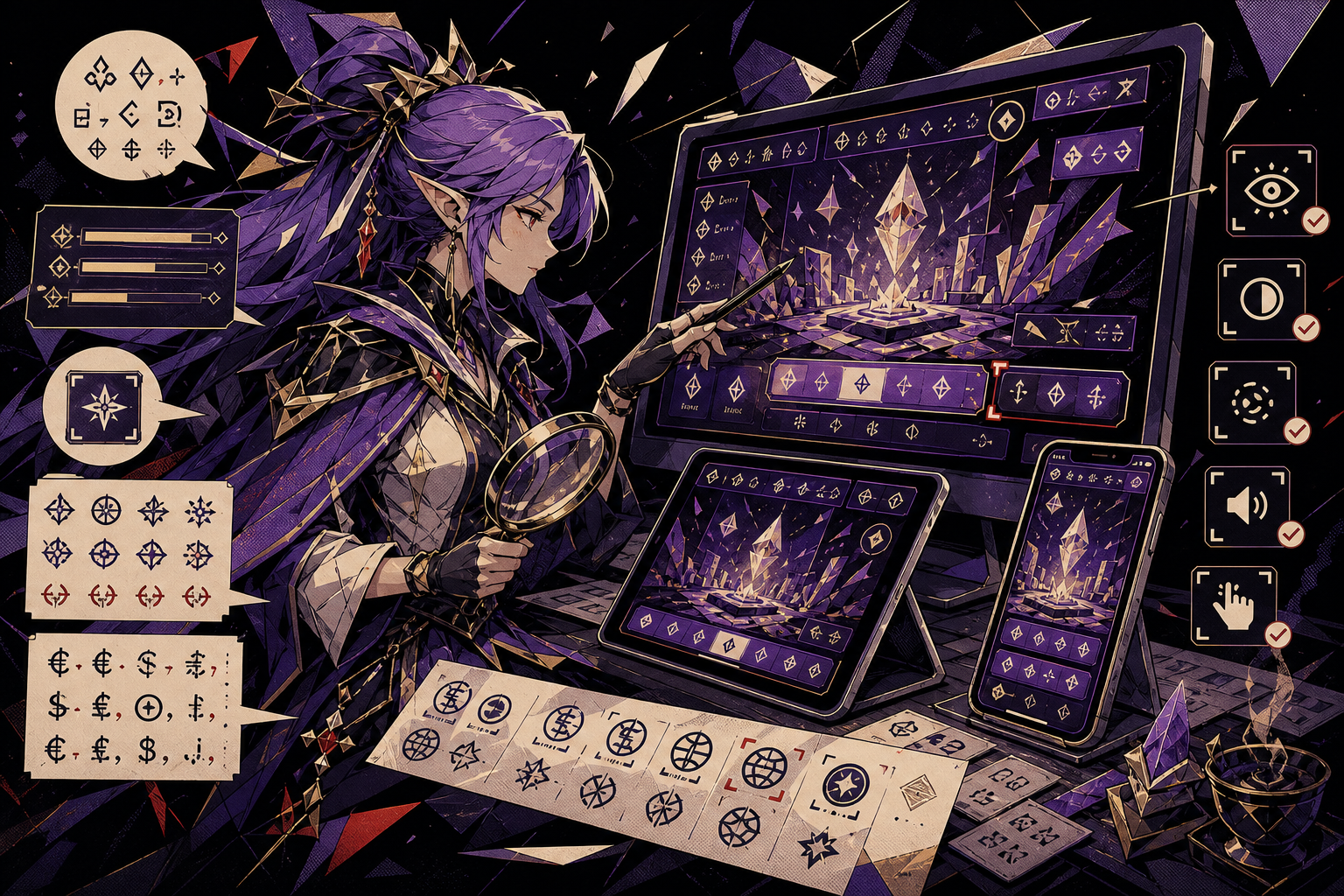
The build should compare every supported locale with the source catalogue. Missing IDs, unexpected IDs, malformed variables and invalid message syntax should fail before deployment. A deliberate fallback chain can preserve usability, but every fallback should emit a diagnostic tied to the game and catalogue versions.
Do not display a raw message ID or an empty label. Those failures can make an essential action impossible to understand. Cache catalogues by immutable version so the shell and messages cannot drift during a release, and keep a rollback path for content independent from game logic when the platform supports it.
Automated screenshots help detect clipping and overflow, but native-language review must confirm meaning, terminology and tone. Run representative rounds in every locale, including low-balance messages, error paths, rules, histories and reconnection. Translation coverage measured only on the opening scene is incomplete.
For custom game development, this architecture keeps one rules contract while letting market and language layers evolve deliberately. It also makes the English-first, reviewed-source workflow reproducible instead of copying a finished scene into several disconnected builds.
Frequently asked questions
What is casino game localization architecture?
Casino game localization architecture separates game state from locale-specific messages, formats, assets and layout rules. One versioned game can then present appropriate language and regional conventions without duplicating its core logic.
Should translations use English text as the key?
No. Stable semantic message IDs survive copy edits and let translators see context. Using an English sentence as the key couples source wording to code and can turn a small editorial change into a missing translation.
How should a casino game format currency?
Use locale-aware number and currency formatting with an explicit currency code, then verify product rules about units and precision. A locale alone does not identify the players account currency.
Can text be baked into game images?
Text should remain outside images whenever possible. Baked text multiplies asset variants, cannot reflow, is harder to expose to assistive technology and can become inconsistent with the message catalogue.
What happens when a translation is missing?
A defined fallback chain can show an approved source message and record the missing ID. It should never expose the raw key, return an empty control label or silently combine incompatible locale data.
How should localized casino games be tested?
Test message completeness, plural and number formatting, layout expansion, font coverage, input, screenshots, accessible names and representative gameplay in every supported locale. Native-language review is still required for meaning and tone.