



















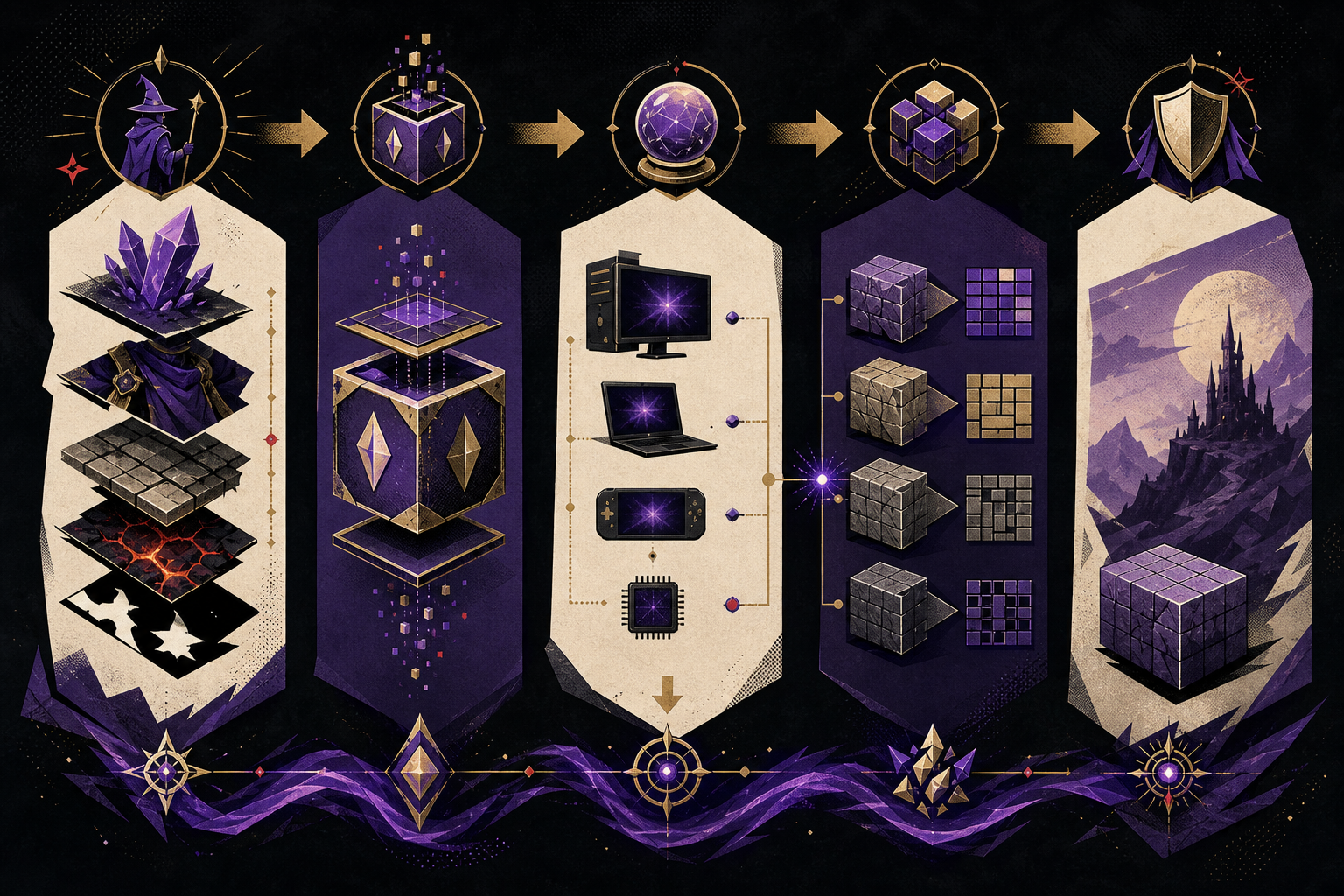
An efficient HTML5 casino game texture pipeline sends one compact source representation, detects the current device’s graphics capabilities and selects a tested GPU format with a complete fallback. The goal is not the smallest file in isolation; it is a faster playable state, controlled GPU memory and acceptable visual quality across the real device matrix.
The KTX 2.0 specification defines a container that can hold mipmaps, supercompressed data and Basis Universal representations intended for transcoding. KTX2 does not guarantee that one encoded asset is ideal everywhere. The loader, transcoder, selected GPU target, fallback and quality settings form one delivery system.

Budget transfer size and GPU memory separately
The downloaded file, decoded image and resident GPU texture are different sizes. A PNG may transfer efficiently but expand substantially when decoded to uncompressed RGBA and uploaded. A GPU block-compressed target can reduce resident memory and texture bandwidth, while an additional supercompression layer can reduce transfer size.
Record all stages for representative assets: source dimensions, encoded bytes, transcode time, selected GPU format, estimated resident size and upload time. Aggregate them by scene and loading phase. A texture pipeline succeeds when the critical scene reaches usable state within its mobile performance budget, not when one sample wins a compression contest.
Set dimension limits by visible use. A reel symbol, full-screen background and small control icon need different resolution and alpha treatment. Reject oversized sources at build time so content updates cannot quietly double a scene’s memory.
Choose ETC1S or UASTC by asset behavior
KTX2 can carry Basis Universal ETC1S or UASTC data. The specification describes both as representations that are transcoded to a GPU-supported compressed or uncompressed format before sampling. They expose different size, quality and processing tradeoffs, so a project should classify assets rather than choose one global setting.
ETC1S can suit color images where smaller transfer size matters and moderate artifacts are acceptable. UASTC can preserve higher detail and can suit normal maps, sharper gradients or assets that expose ETC1S artifacts, but it generally costs more data. Encoder quality, RDO or supercompression settings still need visual and device measurement.
Keep text, thin lines, masks and UI edges in a separate test class. Block compression can distort them even when a detailed background looks acceptable. Essential player information should stay as semantic text where possible; a paytable or control label is not the place to trade readability for a small texture saving.
Generate and verify the complete mip chain
Mipmaps are prefiltered smaller levels used when a texture appears below full resolution. They reduce shimmering and can lower sampling bandwidth, but they increase the encoded texture set and can expose color or alpha defects.
Generate mip levels in the correct color space and inspect transparent edges against the backgrounds used by the game. Straight and premultiplied alpha pipelines can produce halos when tools and shaders disagree. Normal maps and data textures require processing different from color artwork.
Do not include unused mip levels blindly. A fixed-size interface texture may never become small enough to need the full chain, while a zoomable background may use every level. The engine, camera behavior and atlas strategy determine the useful range.
Detect GPU capabilities instead of browser names
WebGL exposes compressed texture families through extensions. The Khronos WEBGL_compressed_texture_etc extension is one example; the broader WebGL extension registry lists standardized capabilities. Query the actual context and verify the target format before uploading.
Build a priority table for tested targets, then fall back to a compatible uncompressed texture when none is available. A failed transcode, corrupt KTX2 asset or lost graphics context must reach the same fallback or recovery path. Do not leave a transparent symbol because an optimization failed.
Cache decisions by device context only for as long as they remain valid. A context restoration or renderer change can require capability re-evaluation. Record the selected target format in low-cardinality telemetry so field failures can be segmented without collecting raw hardware fingerprints.
Stream by playable phase, not file order
Load the assets required for the shell and first playable state before bonus scenes or rare transitions. KTX2 supports mip-level organization that can be used in streaming designs, but the game must decide whether showing a lower-resolution level early is visually acceptable and whether replacing it later causes a distracting transition.
Prioritize semantic completeness: required controls, current symbols and player information before decorative effects. Keep audio and textures on coordinated budgets so parallel downloads do not compete blindly on modest mobile networks.

Make visual and memory regressions fail the build
Create representative golden scenes for each asset class and renderer path. Compare screenshots within defined tolerances, then inspect high-risk regions such as text, gradients, transparent edges and normal-mapped lighting. Automated similarity alone can miss a small but critical symbol defect.
Validate dimensions, mip counts, color-space metadata, alpha mode and permitted target formats during asset build. Run the loader against malformed and unsupported files and confirm it reaches a visible fallback. Track total initial and peak resident texture estimates against declared device-class budgets.
For HTML5 casino games, this pipeline keeps asset reach independent from one browser or GPU family. If the renderer also uses WebGPU, follow the progressive WebGPU rollout and keep texture selection observable in both rendering paths.
The best texture format is the one that preserves required visual information, fits the scene’s network and memory budgets and loads reliably on the target device. That decision belongs to measured asset classes, not to a universal encoder preset.
Frequently asked questions
What is KTX2?
KTX2 is a Khronos container format for distributing GPU textures with metadata, mip levels and options including Basis Universal data and supercompression. A runtime still needs to choose or decode a format supported by the current GPU.
What is Basis Universal used for?
Basis Universal provides portable intermediate texture representations that can be transcoded at runtime to several GPU-supported block-compressed formats. It reduces the need to ship every native format, with quality, decode and implementation tradeoffs to measure.
Do compressed textures improve download size only?
No. A compatible block-compressed texture can reduce GPU memory and upload bandwidth as well as transfer size. Container supercompression and GPU block compression are separate stages, so teams must measure both network and runtime results.
Why do game textures need mipmaps?
Mipmaps provide smaller prefiltered levels for textures shown below their full resolution. They improve sampling quality and can reduce texture bandwidth, but they add encoded data and should be generated with alpha and color-space behavior verified.
How should a browser game choose a texture format?
Detect the actual WebGL or WebGPU capabilities, choose the best tested target format for that device, and keep a complete fallback. Browser name alone does not prove that a particular compressed texture format is available.
Should interface text use GPU texture compression?
Small text and sharp interface edges can show block artifacts. Keep essential text as HTML or high-quality glyph rendering where possible, and evaluate lossless or less aggressive paths for assets whose readability cannot tolerate compression.