




















Most people who have taken an online course have used LMS software without knowing the term. This is what a learning management system does inside WordPress, why LearnDash is the plugin we recommend, and what it cost when we wrote this in 2021.
What LearnDash is
LearnDash is the most popular WordPress Learning Management System plugin, and it works for academic institutions, businesses and solo course creators alike.
An LMS lets users create unlimited courses and organise them in the structure people expect: modules, lessons, quizzes and assignments, with progress visible to learners and to course administrators.
LearnDash adds course prerequisites, access fees and content dripping on top of that, which is what puts it ahead of the other WordPress LMS options.


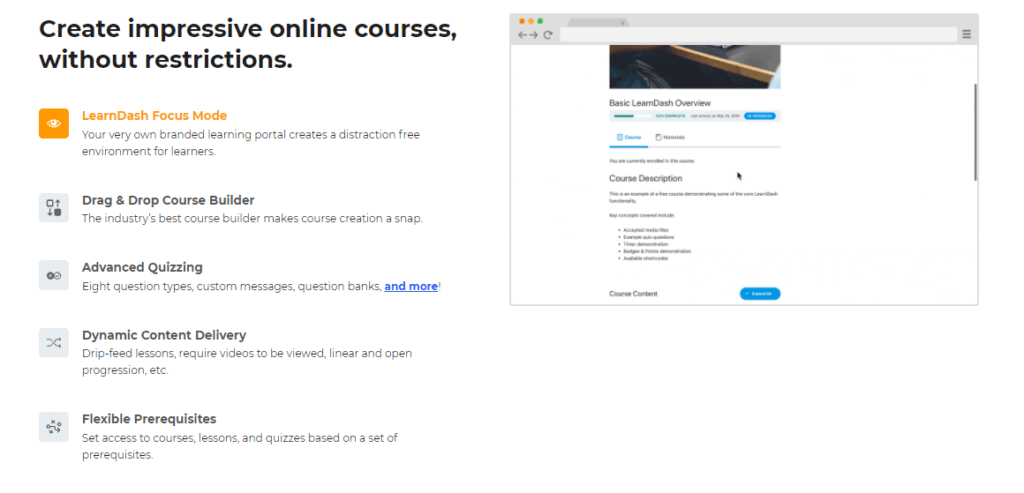
- Builder organises a large course into a comprehensible sequence
- Focus mode presents lessons with progress visible and fewer distractions
- Video support carries previews and resumes across lesson visits
- Quiz tools set passing grades, timers and assessment states
- Drip schedules and prerequisites control when a learner can continue
- Engagement triggers respond to joins, completions and submissions
- Extensions add functions such as ratings, reviews and private messages
The features that do the work
- A drag-and-drop builder, which is what makes a course with many lessons comprehensible and lets you follow a student’s progression through it.
- A distraction-free front end, with content tables and progress bars, because the learner’s experience decides whether a course gets finished.
- Detailed video support, including video previews and a resume video when a learner reopens a lesson.
- A quiz builder covering passing grades, timers and the rest, fast enough that quizzes stop being the thing you postpone.
- Drip content and prerequisites, so material is released on a schedule rather than all at once.
- Engagement triggers, which send custom email automatically when a student joins a course, completes a lesson or submits an assignment.
- A third-party extension marketplace, which is where course ratings, reviews and private messaging come from.
Why an LMS plugin beats the alternatives
Almost anything you want to improve about an eLearning site can be done with a plugin, and the result is courses that feel built rather than assembled.
The saving is time and money together. Registrations, schedules and documents sit in one place, so nobody coordinates individual timetables over email, and the system is available whenever a learner is.
A WordPress LMS plugin also means complete control over the platform and less dependence on a third party. You can reach your own student database for training insights, and the reporting tells you how often learners open the content, when and where they do it, and how long they stay.
Losing work is less of a risk too, because LMS plugins usually offer backups covering course structure, discussions and user progress. And the thing people value most is consistency of delivery: every learner receives the same material.
Who it suits
Solo course creators use LearnDash to build and deliver courses to their members, and it is a straightforward way to monetise a site with free or paid courses.
Businesses use it to run training for employees, and to track progress through a new starter’s onboarding — the same tooling, a different reason.
What it cost in 2021
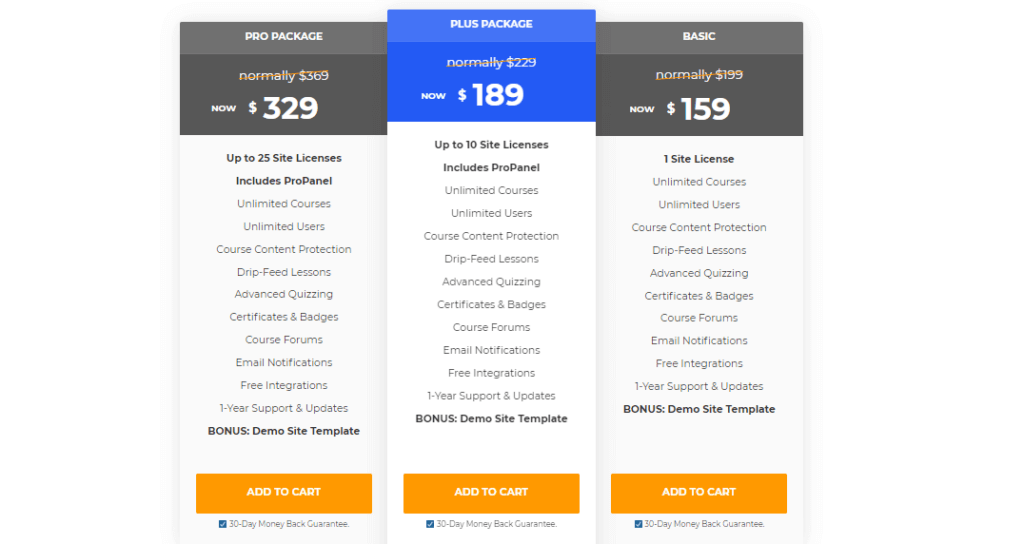
On that page, Basic was $159 for a single site licence, Plus was $189 for up to ten, and Pro was $329 for up to twenty-five and included ProPanel. Each was shown as a discount against a higher list price, and each carried a 30-day money-back guarantee. Those are 2021 prices.
Our verdict
Most WordPress LMS plugins provide the basics — course pages, lessons, progress tracking, analytics — and some offer considerably less, which means installing further plugins and add-ons to get assignments, certificates or quizzes at all.
We found LearnDash to be the most powerful, engaging and intuitive course platform builder available, and the drag-and-drop interface is what lets you start teaching rather than configuring. Our comparison of Wix and WordPress covers the platform decision underneath it, and our services page says what we build on top.
If you want help setting one up, drop us a line.
Frequently asked questions
What is LearnDash?
LearnDash is a WordPress Learning Management System plugin, and it is described here as the most popular one. It suits academic institutions, businesses and solo course creators alike, which is unusual for a plugin in this category.
What does an LMS plugin actually do?
It lets you create unlimited courses and organise them in the structure people expect — modules, lessons, quizzes and assignments — with progress visible to learners and administrators. LearnDash adds course prerequisites, access fees and content dripping on top of that.
Which LearnDash features matter most?
The drag-and-drop builder, because it is what makes a course with many lessons comprehensible; the distraction-free front end, with content tables and progress bars; detailed video support including previews and resume; the quiz builder with passing grades and timers; and engagement triggers that send automatic email when a student joins or completes something.
Why use an LMS plugin rather than a separate platform?
A plugin keeps registrations, schedules and documents in one place, so nobody coordinates individual timetables over email, and it saves money as well as time. It also means complete control over the platform and less dependence on a third party, including access to your own student database and reporting on when and how learners use the content.
Who is LearnDash for?
Solo course creators use it to build and deliver courses to their members, which is a way to monetise a site with free or paid courses. Businesses use it to run training for employees and to track progress through a new starter’s onboarding.
What did LearnDash cost?
On the pricing page this review captured in 2021, the Basic licence was $159 for one site, Plus was $189 for up to ten sites, and Pro was $329 for up to twenty-five, each shown as a discount against a higher list price and each carrying a 30-day money-back guarantee. Those are 2021 prices, read from the screenshot published here and not rechecked.