






















The wpDataTables plugin adds table and chart functionality to a WordPress site. If you want to create original tables and charts without writing code, this is what it does and what it costs. Everything below describes the product as it stood in August 2021.
A short intro to WordPress plugins
Plugins are pieces of software that add a specific feature or functionality to any self-hosted WordPress site. They let a user extend what a website does, and build something new, without prior knowledge of coding or web development. Our review of the best WordPress cache plugin covers a different kind of plugin on the same site.
What wpDataTables is for
wpDataTables inserts static or dynamic data tables into blog posts or pages, and it is the easiest route we have found to visualising and managing a large quantity of data inside WordPress rather than beside it.
The vendor’s own figure at the time of writing was that over 50,000 companies and individuals already used it. That number is quoted here without an independent source, so read it as the vendor’s claim.
Creating a table takes three steps. Enter the table data, by uploading a file, pasting a MySQL query, providing a URL or typing it in manually. Customise it, making it adaptable, editable, and conditionally formatted if you want that. Then share it on a post or a page using either Visual Composer or the standard WordPress editor.

- Advanced display tools cover responsive layouts, formatting, filtering and editor integrations
- Editing tools support back-end, front-end, inline and spreadsheet-style changes
- Data sources include files, feeds, spreadsheets, URLs and database queries
- Chart tools render through HighCharts, Google Charts or Chart.js
- Column types control how numbers, dates, images, prices and percentages behave
- WP admin tools create tables manually or generate database queries
- General resources cover installation, configuration, updates and the creation wizard
- Developer hooks customise front-end and back-end behaviour
The eight groups of wpDataTables features
The plugin was designed to speed up and simplify how data is represented and interacted with. Its features group into eight sections.
Advanced features
Tools for displaying table data: conditional formatting, responsive design, customisation of tables and charts, advanced filtering, and Elementor and Gutenberg integrations.
Table data editing
Tools that let you modify your tables from both the WordPress back end and the front end: editing in WP admin, inline editing, spreadsheet-layout editing and merged cells among them.
Showing table data
Tables can be created from existing data sources: Excel, XML feeds, Google Spreadsheets, MySQL queries, CSV files, the Google Sheets API and private Google Spreadsheets, among others.
Charts
Dynamic charts are rendered by HighCharts, Google Charts or Chart.js. You can edit an existing chart or create a new one through the creation wizard.
Column types and features
You choose the type of each column from a wide range: integer, float, date, time, image, and currency, price or percentage columns among them.
Creating tables in WP admin
Tables can be created manually in WP admin or imported from a MySQL database, and the plugin generates MySQL and WordPress queries against the database.
General information
Documentation on installing, configuring and updating the plugin, plus an overview of the Table Creation Wizard and the Table Configuration page, and a newsletter to subscribe to.
Information for developers
How to customise the front end and the back end: WordPress filters and actions, and front-end object callbacks in charts and tables.
What wpDataTables cost in 2021
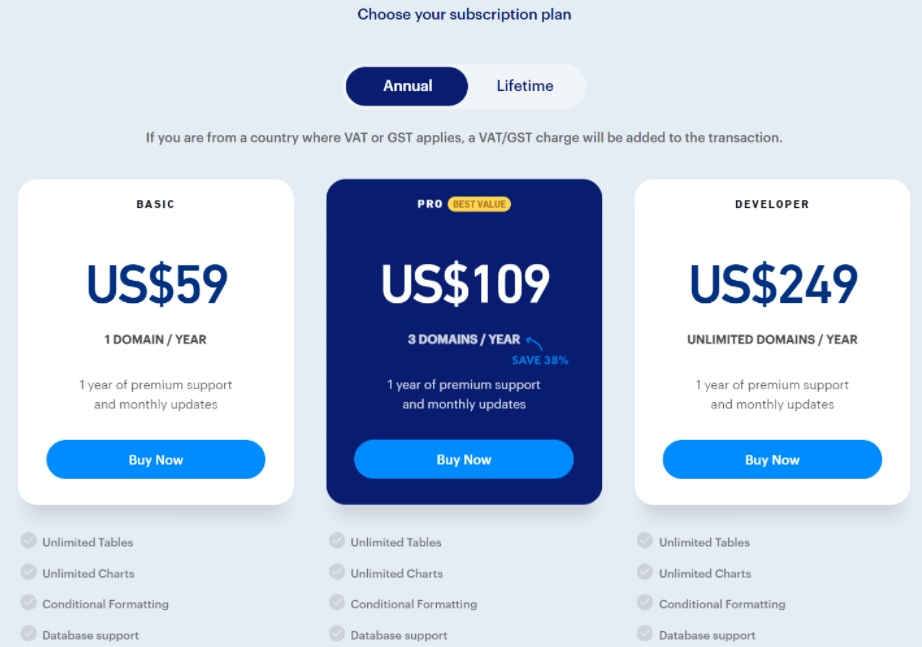
The subscription came in three tiers — Basic, Pro and Developer — separated by how many domains each licence covered, sold annually or as a lifetime licence, each with a year of premium support and monthly updates. The page noted that VAT or GST would be added where it applies.
Our verdict on wpDataTables
wpDataTables inserts a table into any WordPress post or page, reads from the data source you already have, and produces a static or dynamic table in a couple of clicks. That is the whole pitch, and it holds.
Global Wizards rates it as a plugin worth having on a business WordPress site: it is easy to use and it carries enough options to display content properly. That is our own assessment of it rather than a comparative test.
Visit our blog for more, or contact us for a 30-minute consultation.
Frequently asked questions
What does the wpDataTables plugin do?
It inserts static or dynamic data tables into WordPress posts and pages, and builds charts from them, without the site owner writing code. It is aimed at visualising and managing a large quantity of data inside WordPress rather than in a separate tool.
How do you create a table with wpDataTables?
Three steps. Enter the table data, by uploading a file, pasting a MySQL query, providing a URL or typing it in. Customise it, making it adaptable, editable and conditionally formatted if you want that. Then share it on a post or page using Visual Composer or the standard WordPress editor.
Which data sources can wpDataTables read?
Excel, XML feeds, Google Spreadsheets, MySQL queries, CSV files, the Google Sheets API and private Google Spreadsheets, among others. Tables can also be created by hand in WP admin, and the plugin can generate MySQL and WordPress queries against the database.
Which chart engines does wpDataTables support?
Three rendering engines are named here: HighCharts, Google Charts and Chart.js. The plugin can create a new chart through a wizard or edit one that already exists.
What column types does wpDataTables offer?
A set to choose from rather than one generic cell: integer, float, date, time, image, and currency, price or percentage columns, among others. Choosing the type is what makes sorting, filtering and formatting behave correctly further down the page.
What did wpDataTables cost in 2021?
The pricing page captured for this article in August 2021 offered a subscription in three tiers separated by how many domains each covered, on an annual or lifetime basis, with a year of premium support and monthly updates on each, and a note that VAT or GST would be added where it applies. The amounts on that page belong to that date; check the vendor for a current quote.