


















Global Wizards, one of the best mobile game development companies, sets out the steps that make up the game development process and the trends worth watching. Keep reading.
The introduction of Android and iPhone led to a new era in mobile game development. Creating a mobile game is a challenging task involving a great deal of creativity and experience with new technologies, and it is worth separating mobile game development from ordinary mobile application development.
Creating a mobile game gives a company more flexibility and the chance to deliver original ideas. Each game is a unique experience with its own concept and aim. In a hectic lifestyle, a mobile game is a way to reduce stress, get away from everyday problems, or simply spend some free time.
The seven phases of mobile game development
Our team of video game developers works with our own gaming studio to create games for different platforms. These are the stages every one of them goes through.
Game concept development
This is the first and most important stage in the whole development process. A creative spark is one of the most important aspects of creating a successful game.
Many questions need answering to pin down the characteristics of the game according to a client’s wishes. The kind of game, the style, the characters involved, the target audience and the platform are all decided here, before anything moves on.
Pre-production
This part of the process usually brings new challenges, because it is where the development team is prepared for production.
Teams from different areas of the company — designers, writers, developers and engineers, and artists — work together adjusting details. Pre-production is also when team members settle the narrative themes and key characters, so the game’s story can be told effectively.
Production
Production begins with a clear idea of the game environment and characters, the interface design and the control schemes. Your team will still see changes to the business model and to development mechanics; the work is to absorb new requirements while staying on pre-agreed deadlines.
The production team handles character models and rendering, the audio, and the game levels, so that everything comes together before release. It takes time and effort, and it is the part of developing for mobile that cannot be compressed.
Testing
Testing is essential. A game has to work correctly on different platforms before it launches, so that whoever plays it gets the experience it was designed for. A strong testing team provides thorough feedback about how users interact with each feature, which is what tells you whether an aspect should change or stay.
When the tests are done, the game is ready for the pre-launch stage.
Soft launch
To make sure the product is ready, all its features and functions are tested by developers. Before a full launch, developers often release the game in test markets or on localized platforms to see how users actually interact with it.
At pre-launch, marketing strategies promote the game and make the audience aware of it. One last push and it is ready to go.
Launch
This is the stage the whole team waits for, because the effort finally pays off.
After the game is fixed and the pre-launch data is in, it is time to release a finished product. Users then provide the feedback that improves their gaming experience further.
Even with the game released, one stage is still to come, and it matters as much as the rest.
Post-production
It is important never to stop evolving. When a large number of players have discovered most of the levels in your game, it is time for updates or new versions that release more content with fresh ideas.
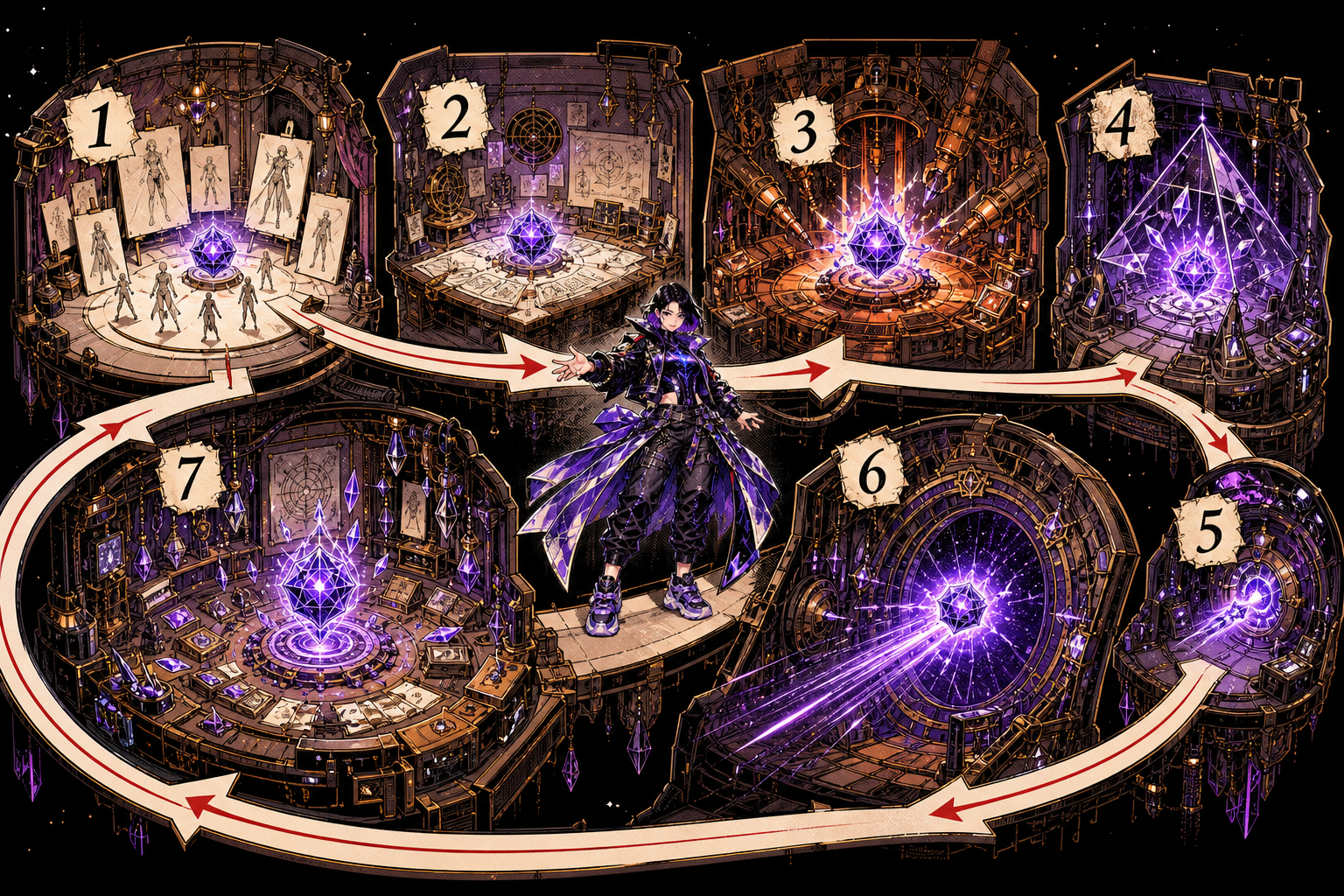
- Concept defines the kind of game, visual style, characters, audience and platform
- Pre-production aligns design, writing, engineering and art around the details production needs
- Production builds environments, characters, controls, audio and levels
- Testing checks the experience across platforms and turns interaction into feedback
- Soft launch exposes the game to selected markets while release marketing begins
- Launch releases the finished product and opens a wider feedback channel
- Post-production adds updates, versions and fresh content after players explore the game
Four trends in mobile game development
Global Wizards keeps up with mobile game development news, and these are the trends we see growing.
Multiplayer games
The thrill of competitive gaming is sharper with multiplayer modes that let opponents meet across platforms. You can also compete against virtual opponents on your own, in single-player or local network games.
Social games
Social games are played online and require social network integrations. They let people stay connected with friends wherever they are. Candy Crush is the obvious example of the category.
Location-based games
In a location-based game, play progresses according to where the player physically is. The usual way to get that information is GPS, and many developers now build on it.
Phone accelerometer
The accelerometer senses movement and gravity, which lets it work out the angle at which a phone is being held. Games use it as a controller, measuring player actions such as tilt and speed.
Why Global Wizards builds mobile games
Creating a successful game is not only about the right idea; it is about executing it. Developing for iOS and Android is not easy, and Global Wizards offers game development services that guide a client through every step above. Our note on how to start a gambling website covers the same ground for an operator rather than a studio.
We specialise in games for mobile, and we take an idea further through images and animation. Our experience covers mobile, console and virtual reality platforms.
If you want to know more about what we do, contact us. Let the game begin.
Frequently asked questions
What are the phases of mobile game development?
Seven, in the order this article sets them out: game concept development, pre-production, production, testing, soft launch, launch and post-production. Each one hands something specific to the next, which is why skipping one usually shows up two stages later rather than immediately.
What happens during game concept development?
It is the first and most important stage, and it is where the questions that decide everything else get answered: what kind of game it is, the style, the characters, the target audience and the platform. A creative spark matters here more than anywhere, because the rest of the process executes this decision rather than revisiting it.
What does pre-production involve?
Pre-production is where designers, writers, developers, engineers and artists work together adjusting the details production will need. It is also when the team settles the narrative themes and key characters, so that the story the game tells can actually be told.
Why do developers use a soft launch before a full launch?
Before launching a game, developers often release it in test markets or on localized platforms to see how real users interact with the product. That is what a soft launch is for, and it runs alongside the marketing work that makes an audience aware of the release.
What happens after a mobile game launches?
Post-production, which matters as much as the stages before it. Once a large number of players have worked through most of the levels, it is time for updates or new versions that release more content, because a game that stops changing stops holding an audience.
What trends are shaping mobile game development?
Four are named here: multiplayer games that let opponents meet across platforms, social games built on social network integrations, location-based games where progress depends on where the player physically is, usually through GPS, and games that use the phone accelerometer as a controller to measure tilt and speed.