



















Regulated crypto casinos have moved onto hybrid decentralized platforms, and the technical substance of that is Layer-2 scaling — specifically Zero-Knowledge Rollups — carrying gasless transactions and real-time smart contract auditing. The model replaces opaque off-chain systems, and it turns crypto gambling from a niche into a compliant business-to-business ecosystem. The pressure behind it is regulatory as much as technical: alignment with international requirements, without giving up the speed a player expects.
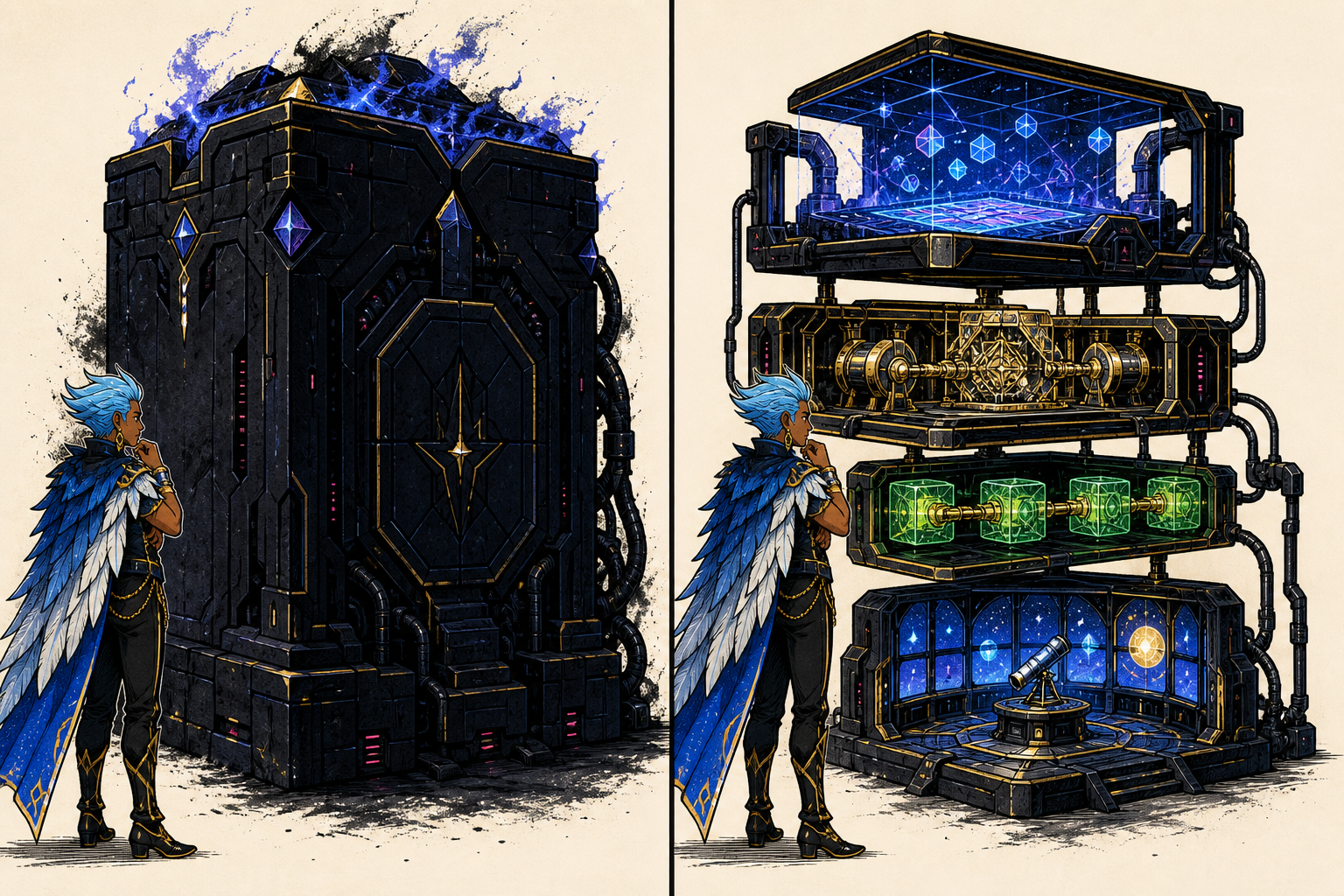
- Opaque monolith — execution, custody and audit hidden together.
- Inspectable hybrid — presentation stays fast while proof, settlement and oversight remain separate.
Three things arrived at once. Sustained regulatory pressure from the European Union and modernised licensing regimes demanded higher transparency; Ethereum Layer-2 solutions matured to the point where high-volume wagering became economically viable; and the market began asking for what the industry calls Provably Fair 2.0, in which every outcome is verifiable on a public ledger without slowing the interface down.
What on-chain logic replaced, and why
On-chain logic means the Random Number Generator and the payout mechanics execute inside immutable smart contracts, so an outcome cannot be altered and funds cannot be withheld by editing a database. That is a direct response to the liquidity crises and project failures of 2024 and 2025, which showed what a centralised server holding both the logic and the money can do. The hybrid part is that graphics stay on centralised servers, which is how the approach avoids the latency that made earlier decentralized applications unusable.
MiCA Article 48 and the move to zero-knowledge proofs
Article 48 of the Markets in Crypto-Assets framework requires crypto-asset service providers to meet strict custody and anti-money laundering obligations, and that is what made zero-knowledge proofs necessary rather than merely attractive. A ZK proof verifies player eligibility and fund solvency without exposing the underlying personal data, which lets an operator satisfy a European regulator and a privacy-conscious player at the same time. The technical bar this sets also functions as a filter, because meeting it is not cheap.
The L2-Bet Standard for live dealer streams
A consortium of major B2B suppliers has announced the L2-Bet Standard, which connects live dealer video streams directly to Layer-2 wallets such as those on the Polygon ZK-EVM. For the first time a player can verify the cryptographic proof of a particular card deal or roulette spin as the round runs, rather than trusting the feed. Standardising how live data is written on-chain is what lets suppliers including Evolution and Pragmatic Play set a shared baseline instead of each defining its own.
Verified Mini-Apps on TON, and the super-app pattern
Tier-1 operators have partnered with The Open Network to release Verified Mini-Apps inside messaging platforms, using sharding to reach sub-second wagering speeds without a standalone download. Removing the install step removes the largest drop-off in mobile acquisition, and it puts wagering next to conversation rather than in a separate place. It is the super-app pattern applied to gambling: several services consolidated behind one fast interface.
Aero-Slots and crash points fixed before the round starts
Spribe’s Aero-Slots is the first social-crash hybrid designed for high-end virtual and mixed-reality headsets, and its mechanism is the interesting part. The crash point is determined and written to the ledger before the round begins, then revealed to every participant after it ends. That makes the social element cryptographically backed rather than trust-backed, which is the specific weakness multiplayer social games have always had.
Curacao phase three: real-time proof of reserves
The Curacao Gaming Control Board has entered the third phase of its implementation plan, requiring every digital asset licensee to publish real-time proof of reserves. Meeting it has driven demand for automated oracle services from third-party firms such as Chainlink, which supply a continuous tamper-proof feed of a casino’s liquidity. The move from periodic manual audit to continuous monitoring changes what holding a licence actually consists of.
The Travel Rule and zkKYC
Compliance requirements tightened again with the Financial Action Task Force Travel Rule, which requires originator and beneficiary information for crypto-asset transactions above a threshold typically set at 1,000 euros. Zero-Knowledge KYC is how the industry meets that without storing passport images on a central server: the casino verifies that a player meets age and residency requirements, and keeps nothing that would be worth stealing.
The games leading on daily active users
Plinko Z leads the sector on daily active users, and the reason given is that its physics engine is verified by cryptographic proof rather than asserted. Chain-Reaction Crash lets players form syndicates through smart contracts that split winnings automatically, which makes a trustless partnership between strangers possible. And the Slot-DAO model returns part of the house edge to players holding governance tokens, decentralising the profit rather than only the logic.
The UK white paper on on-chain only operators
The UK Gambling Commission has published a white paper exploring the licensing of on-chain only operators, subject to strict smart contract audit requirements. It signals a possible opening of the British market to regulated crypto gambling, and more broadly a regulator moving from restriction toward technical monitoring. In high-stakes poker the same logic has already become a purchasing criterion: Mental Poker protocols, which shuffle cryptographically without a central server, are now a prerequisite for platform selection among professionals.
What regulators and operators say has changed
Elena Rodriguez, Head of Digital Innovation at the Malta Gaming Authority, describes the move from trust to verification as a major leap in player protection, with smart contract auditing letting a regulator monitor game mathematics in real time instead of reading an annual report. Marcus Sterling, chief executive of a prominent B2B aggregator, makes the commercial version of the same observation: fiat operators are adopting Layer-2 backends for faster settlement and lower auditing costs, so the distinction between traditional and crypto casinos is blurring from both sides.
Julian Dashwood, a consultant in blockchain compliance, puts the weight on zkKYC. Verifying eligibility without storing sensitive personal data removes the breach risk rather than mitigating it, and as the tooling gets cheaper the platforms that treat data sovereignty as a feature are the ones consumers will notice.
What the trust premium is worth
Companies adopting Layer-2 integrations have seen a 12 percent rise in average share price during the first quarter of the year, on market data reported rather than measured here, while legacy platforms resisting on-chain transparency have lost player retention. The industry calls the gap a trust premium, and it now drives both player acquisition and capital allocation.
The direction from here is more scalability and a simpler interface, not a change of course. Removing gas fees through ZK-Rollups has already taken out the largest barrier for a casual player, and with regulators wanting real-time access and players wanting provable fairness, traditional and crypto-native operators are converging on one standard. The same convergence is described from the licensing side in hybrid-regulated crypto casinos and from the payments side in MiCA-compliant stablecoins and ZK-proofs.
If you are building on this stack and it has to pass an audit, our gambling software and certification and compliance teams cover both halves — talk to us.
Frequently asked questions
What is on-chain logic in a crypto casino?
On-chain logic is the arrangement in which the Random Number Generator and the payout mechanics execute inside immutable smart contracts rather than on a centralised server. It removes the ability to alter an outcome or withhold funds through a database edit, which is what the liquidity crises and project failures of 2024 and 2025 exposed in the previous model.
What does MiCA Article 48 require of a crypto casino?
Under Article 48 of the Markets in Crypto-Assets framework, a crypto-asset service provider must adhere to strict custody and anti-money-laundering protocols. Meeting them without exposing personal data is what pushed operators toward zero-knowledge proofs for verifying player eligibility and fund solvency.
What is the L2-Bet Standard?
The L2-Bet Standard is a unified protocol announced by a consortium of major B2B suppliers that connects live dealer video streams directly to Layer-2 wallets, including those on the Polygon ZK-EVM. It is what lets a player verify the cryptographic proof of a specific card deal or roulette spin while the round is happening.
What are Verified Mini-Apps on TON?
Verified Mini-Apps are wagering applications released inside messaging platforms through partnerships between Tier-1 operators and The Open Network. They use sharding to reach sub-second wagering speeds and remove the need for a standalone mobile download.
What does the Curacao proof-of-reserves requirement involve?
In the third phase of its implementation plan, the Curacao Gaming Control Board requires every digital asset licensee to provide real-time proof of reserves. Operators meet it with automated oracle services from third-party firms such as Chainlink, which publish a continuous tamper-proof feed of the casino’s liquidity.
What is the Slot-DAO model?
In the Slot-DAO model a portion of the house edge is distributed back to players who hold governance tokens, which decentralises the house profit rather than only the game logic.