



















Las Vegas is a cathedral of neon lies. You walk in believing you are in a fair fight with Lady Luck. You are not. Luck is the ghost story casinos tell so you never look at the math behind the spin.
In June 2014, a crew of mathematicians out of St. Petersburg, Russia stopped guessing and started reading. Over 48 hours at the Lumiere Place Casino in St. Louis, Missouri, they walked out with $21,000 drained from slot machines they had never touched before. No crowbars, no malware on the cabinets, no inside men. Just a smartphone, a server farm five thousand miles away, and a buzz that arrived a quarter second before each jackpot.
This is the technical autopsy of that heist — and why every operator running legacy slot game cabinets on pseudo-random number generators is still vulnerable to the same exploit a decade later.

The Heist at Lumiere Place — What Happened in June 2014
The accountants saw the blood first. The cabinets on the casino floor were spitting out seven cents more per dollar than the math allowed. In this business, that is not a streak. That is a hit.
The hole was concentrated in the older Aristocrat Mark VI cabinets — units installed years earlier, when the Australian manufacturer was still shipping them by the thousand. When the casino’s surveillance team pulled the tapes, they found a single man standing at the machines, recording two dozen spins on his phone, waiting for a few seconds, and pressing the spin button at moments that looked almost arbitrary. He was winning anyway. Steadily. Surgically.
That man was Murat Bliev. He was not the architect. He was the scout. The brains of the operation were five thousand miles east, sitting in front of monitors in a converted apartment in St. Petersburg.
The Modus Operandi — How a Smartphone Beat a Multi-Million Dollar Cabinet
The trail did not start in Missouri. It started in 2009, when the Kremlin banned casinos across Russia and operators were forced to liquidate their floors. Thousands of Aristocrat Mark VI cabinets ended up sold as scrap at fire-sale prices. Most buyers saw obsolete furniture. A crew of out-of-work mathematicians in St. Petersburg saw a laboratory.
For roughly five years, they performed a digital autopsy on those cabinets. They reverse-engineered the firmware. They mapped the pseudo-random number generator that controlled every spin. They identified the predictable timing patterns embedded in the cabinet’s logic. And then they built an operation around it.
The execution itself was almost mundane:
- Scout phase. An operative — Bliev was one of several — would stand at an Aristocrat Mark VI machine and film roughly twenty spins on a smartphone. He was not capturing the symbols. He was capturing the precise timing of the reels, down to the millisecond.
- Transmission phase. The encrypted video was sent five thousand miles to a server farm in St. Petersburg.
- Analysis phase. A brute-force algorithm crunched the timing data to identify the PRNG seed driving that particular cabinet at that particular moment.
- Execution phase. The server transmitted a signal back to the operative’s phone — not a text message, a physical vibration sent exactly 0.25 seconds before the winning millisecond. The operative waited for the buzz, pressed the spin button, and the machine paid out.
The operative did not need to look at the screen. He did not need to know how the game worked. He needed to feel his pocket buzz and react inside a quarter-second window. The math was happening in Russia. The button press was happening in Missouri. The slot machine was the messenger.
PRNG Explained — Why Linear Congruential Generators Are Glass Walls
Most players believe the spin is a roll of the dice. It is not. What RNG means in gambling is closer to a script — a long, deterministic list of commands that runs from a starting point called a seed and produces a sequence of numbers that look random to anyone who does not have the formula.
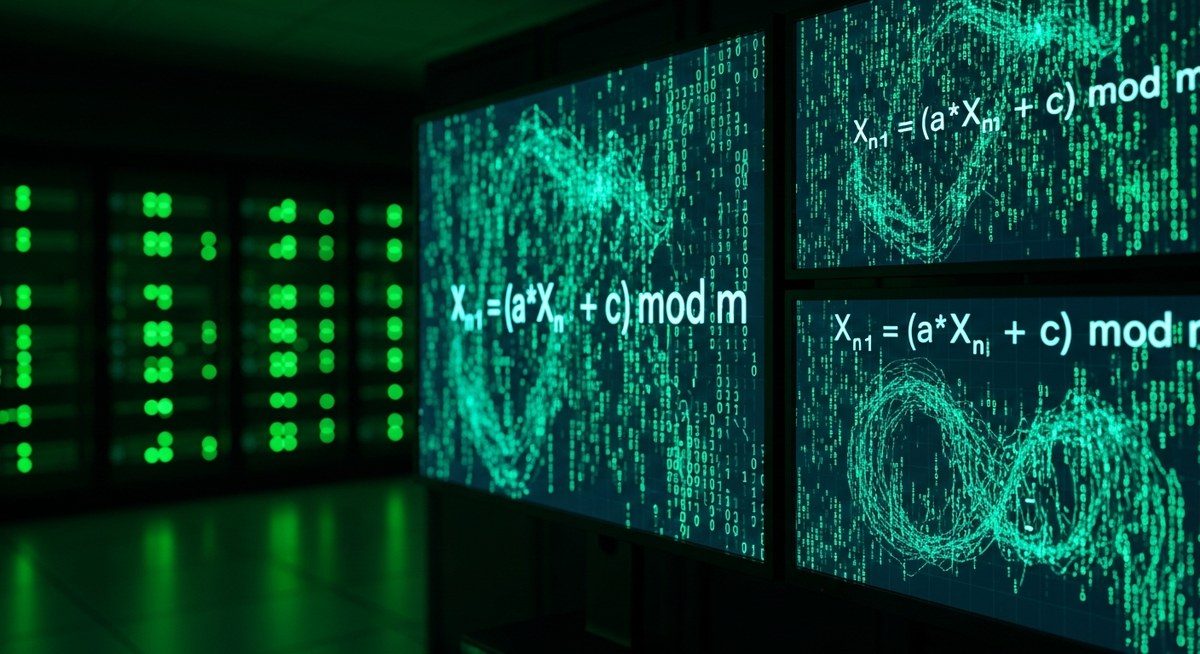
The older Aristocrat Mark VI cabinets ran on a linear congruential generator (LCG). The formula is short enough to fit on the back of a business card:
Xn+1 = (a · Xn + c) mod m
Where Xn is the current state, a, c and m are the constants embedded in the cabinet’s DNA, and the seed X0 is the initial value that starts the entire sequence.
Once you know the four constants, the only mystery left is the seed. And once you have the seed, the machine is no longer a slot — it is a calendar. You know exactly when every winning combination is going to appear, down to the millisecond.
The Russians never broke into the firmware. They never tampered with the hardware. They observed twenty spins, extracted the latency between cycles, fed it to a brute-force solver in St. Petersburg, and recovered the seed. The cabinet kept doing exactly what it was designed to do. The crew simply knew what it was going to do next.
This is the structural weakness of every PRNG built on a deterministic algorithm: if the attacker can observe enough output to derive the seed, the entire sequence becomes predictable. How developers implement RNG in slot games today looks very different precisely because of cases like Lumiere Place.
The Execution and the FBI Takedown
The plan was elegant on paper. It had a single blind spot: human greed. Or, more precisely, the survival instinct of a casino floor that has watched too many people walk out with too much money.
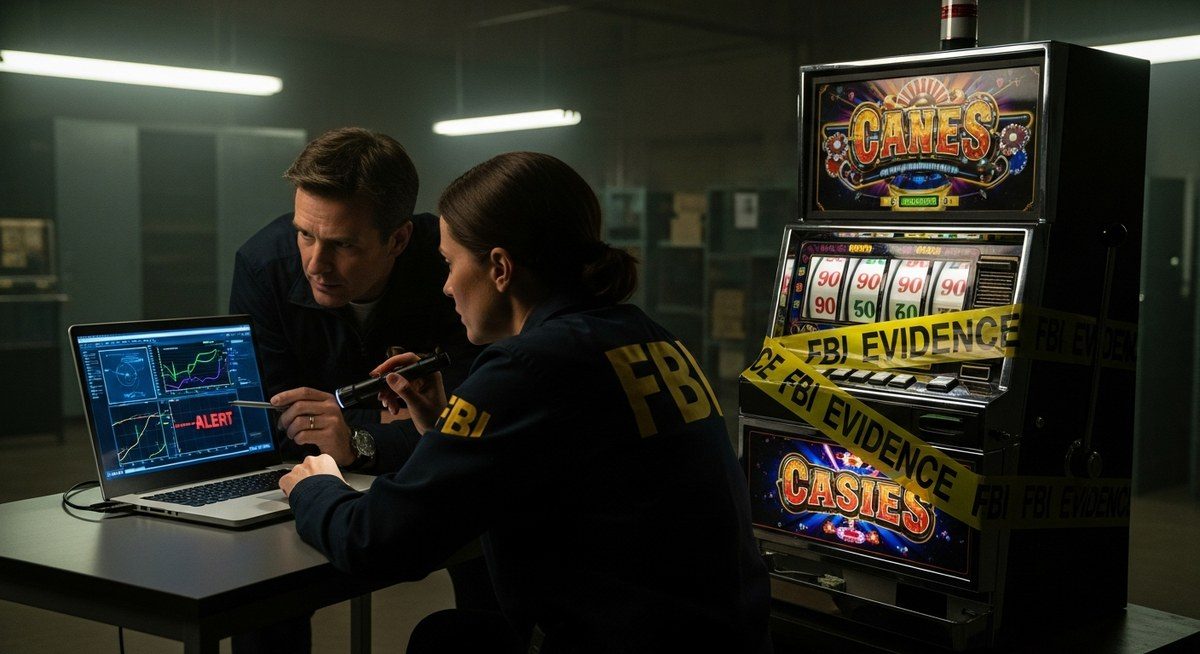
Lumiere Place noticed the pattern within 48 hours. One man, two days, $21,000 in steady wins on cabinets with a known house edge — that is not a streak. That is a signal. They pulled the surveillance, identified Bliev, and called the FBI.
Federal agents tracked him to a rental car. Inside, they found a smartphone, a list of casinos, and a quietly efficient toolkit for filming and timing slot machine spins. Bliev took a plea deal. In exchange for a reduced sentence he gave up the structure of the operation — the St. Petersburg bot factory, the analysis team, the transmission protocol.
The masterminds were never caught. They were in Russia. They are still in Russia, presumably running variations of the same exploit against any operator anywhere in the world still trusting a vulnerable PRNG to protect the house.
The takedown was not a math failure. The math was perfect. The takedown happened because a perfect win, repeated steadily, leaves the loudest possible signature in a casino’s reporting system. In an industry built on algorithms, your biggest enemy is the data trail you leave behind.
The Aftermath — How the iGaming Industry Responded
After St. Louis, the gambling industry did more than panic. The floor gave way under a generation of cabinets. Operators realized that the secure algorithms they had been deploying for two decades were, in the worst cases, open books for anyone with enough processing power and patience to read them.
Aristocrat Mark VI cabinets were patched, retired, or quietly sold for scrap. The patches were band-aids — you cannot fix a deterministic algorithm by tweaking it. You can only replace it.
The shift that started in 2014 was not a software update. It was an architectural rewrite of how gambling outcomes are generated. GLI certification requirements hardened. State regulators began demanding evidence of cryptographic randomness, not just statistical randomness. Independent labs raised the bar on what they would actually certify as a gaming RNG.
For operators still running legacy cabinets, the implication is simple: a machine certified ten years ago against a 2014 standard is not a secure machine in 2026. The slot machine math model can be perfect on paper and still be exploitable if the underlying number generator is deterministic.
From PRNG to TRNG — Building RNG Math Cannot Crack
Modern high-end casinos do not rely on a formula anymore. They rely on physics.
The replacement for pseudo-random number generators is a class of hardware called true random number generators, or TRNGs. Instead of computing the next number from a deterministic seed, a TRNG draws entropy from physical phenomena that are impossible to predict from outside the device:
- Atmospheric noise — capturing the static hiss of radio waves and converting it to a bitstream.
- Thermal fluctuations — measuring the small, chaotic variations in voltage across a semiconductor as it heats and cools.
- Quantum decay — observing the timing of radioactive decay events, which are genuinely random at the subatomic level.
- Photonic systems — using single-photon detectors to capture quantum-level randomness from beam splitters.
None of these can be reverse-engineered from a smartphone video. None of them have a seed. None of them produce a sequence that an algorithm in St. Petersburg can predict. The Russians could film a TRNG-backed cabinet for a thousand years and still have no idea what the next spin would deliver.
But here is the unromantic truth most casino marketing will not tell you. As long as there is a developer writing code, there is a vulnerability. A TRNG chip can be flawless and the integration layer above it can leak entropy. A cryptographic seed can be perfect and a logging routine can write it to disk. Provably fair gaming systems emerged precisely because operators stopped trusting that their own RNG implementations were as secure as the chips underneath.
How Wizards Builds Provably Secure Gambling Software
Most casinos are running on borrowed time and predictable code. We build the walls math cannot climb.
At Wizards we handle the entire technical spectrum from slot cabinets to crash games using certified RNG systems that turn luck into unbreakable physics. Our secure gambling platforms integrate hardware-backed entropy sources, audited cryptographic libraries, and full chain-of-custody for every spin from seed to symbol. The certification work is handled by our gambling certification services team — independent labs, regulator submissions, and the documentation trail that survives an FBI-style forensic audit.
In a world of digital ghosts, we provide the only thing that is real: a house built on code, not lies.
Want the full story? Watch the documentary breakdown
The article above is the technical autopsy. The video version is the noir — narrated by Mr. Polti, with the kind of frame-by-frame breakdown of the Lumiere Place heist you do not get in a written piece. If you want to see how the timing analysis actually worked, how the FBI closed in on Bliev, and why the masterminds are still operating from St. Petersburg today, the eight-minute documentary lays it out cold.
→ Watch “How Hackers ‘Read’ the Mind of a Slot Machine — The RNG Ghost” on YouTube
In this house, we do not bet on luck. We bet on engineering. Reach out to our team when you are ready to evaluate the technical floor your operation is actually standing on.
Frequently Asked Questions about the Aristocrat Mark VI RNG Hack
What was the Aristocrat Mark VI hack?
The Aristocrat Mark VI hack was a 2014 exploit in which a Russian crew based in St. Petersburg reverse-engineered the pseudo-random number generator (PRNG) in legacy Aristocrat Mark VI slot cabinets. Operatives filmed roughly twenty spins per machine, transmitted the timing data to servers in Russia, recovered the PRNG seed via brute force, and then received timed vibrations on their phones telling them when to press the spin button. The operation drained $21,000 from Lumiere Place Casino in St. Louis over 48 hours in June 2014 before the FBI moved in.
How much money did the Lumiere Place slot machine hack steal?
Lumiere Place Casino in St. Louis lost approximately $21,000 over 48 hours in June 2014. The variance that triggered the investigation was about seven cents more per dollar than the cabinets’ programmed house edge would allow — a small enough margin to look like noise on any single spin but a statistically impossible signal across hundreds of spins by a single player. Total losses across the broader operation, which targeted multiple casinos worldwide, are estimated significantly higher.
What is a PRNG and why is it vulnerable to timing analysis?
A pseudo-random number generator (PRNG) is a deterministic algorithm that produces a sequence of numbers that appear random but are actually computed from a starting value called a seed. The older Aristocrat cabinets used a linear congruential generator, which can be expressed as X(n+1) = (a · X(n) + c) mod m. If an attacker observes enough output values — even indirectly, through reel timing — they can derive the seed and predict every future output. Modern slot machines use true random number generators (TRNGs) drawing entropy from physical phenomena to eliminate this attack class.
Who was Murat Bliev and what role did he play?
Murat Bliev was one of several operatives the St. Petersburg crew deployed inside US casinos. He was not the architect of the exploit — he was the scout. His job was to film about twenty spins on each target cabinet with a smartphone, transmit the encrypted video to the analysis team in Russia, and then return to the cabinet hours later to press the spin button on cue when the server sent him timing pulses. The FBI tracked him to a rental car in 2014. He took a plea deal that exposed the structure of the St. Petersburg operation but did not produce the masterminds, who remained in Russia.
What is the difference between PRNG and TRNG?
A PRNG (pseudo-random number generator) produces numbers from a deterministic algorithm seeded with an initial value. Given the same seed, it produces the same sequence every time. A TRNG (true random number generator) draws entropy from physical phenomena such as atmospheric noise, thermal fluctuations in semiconductors, quantum decay events, or photon arrival times. A PRNG can be reverse-engineered if enough output is observed. A TRNG cannot, because there is no algorithm to reverse — the randomness comes from physics, not math.
Can modern slot machines still be hacked through RNG analysis?
Modern cabinets using hardware TRNGs and audited cryptographic integration layers are not vulnerable to the specific timing analysis exploit used at Lumiere Place. However, the integration layer between the entropy source and the game logic remains a potential attack surface. Legacy cabinets still in operation around the world — particularly in jurisdictions with looser certification regimes — remain exposed to PRNG-based exploits. The general principle stated by security researchers since 2014 is straightforward: as long as a developer is writing code, there is a vulnerability somewhere in the stack.
How do iGaming developers prevent RNG attacks today?
The current best practice combines four layers. First, a hardware TRNG draws entropy from a physical source. Second, that entropy feeds a cryptographically secure PRNG (CSPRNG) seeded continuously from the hardware source, providing high-throughput generation. Third, the entire pipeline is audited by independent labs such as GLI or BMM under standards like GLI-19 for interactive gaming systems. Fourth, regulators require continuous monitoring and reporting of variance against expected return-to-player figures, so anomalies are flagged within hours rather than weeks — the gap that allowed the 2014 hack to continue undetected long enough to be profitable.
Where are the St. Petersburg masterminds now?
The masterminds behind the operation were never extradited. The FBI’s plea deal with Bliev exposed the structure of the bot factory but did not reach the principals, who remained in Russia outside the jurisdictional reach of US law enforcement. Industry analysts assume similar operations are still active, targeting any legacy PRNG-based cabinet that remains in service worldwide. The original Aristocrat Mark VI exploit has been documented and patched, but the methodology — reverse-engineering a deterministic generator from observed output — applies to any deterministic system that has not been hardened against it.
Watch on YouTubeOpens YouTube in a new tab.