







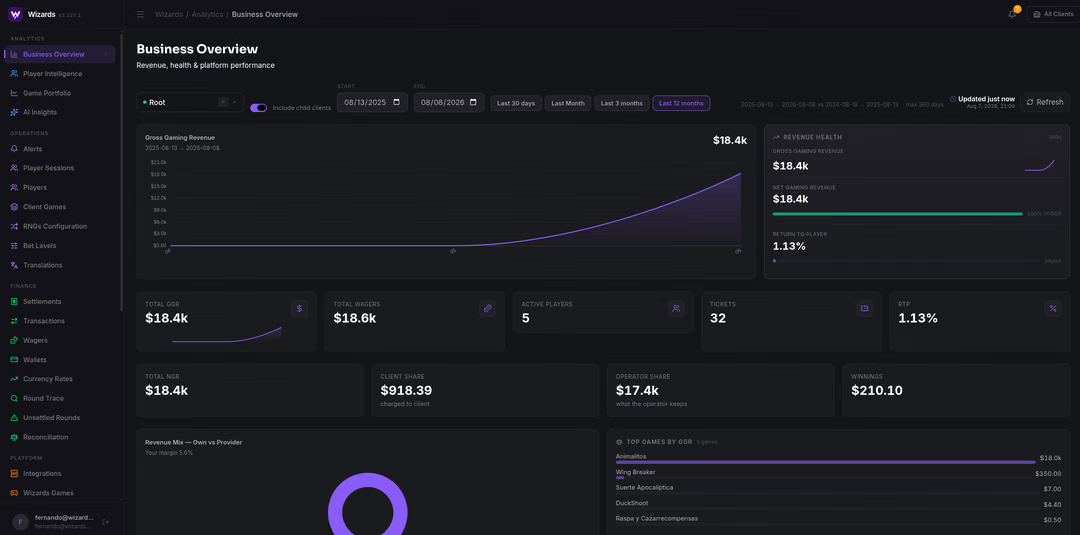













Gross Gaming Revenue (GGR) measures what players lose, but it often masks how profitable an iGaming operation really is. Net Gaming Revenue (NGR) exposes the deductions that decide an operator’s true earnings, and reading the numbers this way reveals far more than any top-line figure.
Many operators lean on GGR alone and misjudge profitability, overlooking the bonuses, taxes, and payment costs that quietly erode margins. We help operators turn raw revenue into decisions that hold up as a full-service iGaming & Digital Marketing Solutions Provider.

Why Gross Gaming Revenue (GGR) is not your true profit number
Gross Gaming Revenue represents the total amount players wagered minus their winnings paid out. This figure provides a quick snapshot of the gross income generated from gaming activities before any operational costs or deductions are considered.
Regulators often use GGR as a baseline for calculating gaming taxes and for general market sizing, offering a standardized metric across different jurisdictions. If you want the full breakdown of that top-line metric on its own, our guide to what GGR means in gambling covers it in depth.
Despite its prevalence, focusing solely on GGR can lead to a misleading perception of an operator’s financial success. It often fails to account for the significant expenses incurred in running an iGaming business, such as player promotions, regulatory fees, or the costs tied to game providers and payment processors.
Misinterpreting these metrics, particularly without understanding the full scope of ngr gambling, can push operators toward unsustainable business models and missed opportunities for optimizing profitability.
Understanding your NGR gambling components
Net Gaming Revenue gives a much clearer picture of what an iGaming operator truly retains after deductions that, if ignored, distort financial health. Your NGR calculation begins with GGR, from which several key expenses are subtracted to reflect the revenue actually available for core operations and profit.
In its simplest form: NGR = GGR − player bonuses − gaming taxes − payment processing fees − game provider royalties − affiliate commissions. Each of those deductions deserves a closer look, because that is where profitability is won or lost.
- Player Bonuses and Promotions: These include welcome bonuses, free spins, cashback offers, and loyalty programs. While effective for acquisition and retention, their costs directly reduce net revenue.
- Gaming Taxes and Regulatory Fees: Jurisdictions impose various taxes on gaming revenue, alongside licensing and compliance fees. These mandatory payments are a substantial deduction from GGR.
- Payment Processing Fees: Each transaction, whether deposits or withdrawals, incurs fees from payment gateways, banks, and e-wallets. Chargebacks also contribute to these costs.
- Game Provider Royalties and Fees: Operators typically pay a percentage of the revenue generated by third-party games to the game developers or platform providers.
- Affiliate Commissions: A significant portion of marketing spend goes to affiliates who drive traffic and player registrations. These commissions are a direct deduction from GGR.

How NGR gambling reveals your casino’s actual financial health
NGR offers a transparent view into your operation’s actual profitability, moving beyond the superficial figures of GGR. For internal financial planning and budgeting, it is the more reliable metric. Operators often see GGR figures growing, but without a corresponding rise in NGR, it signals that operational costs are eroding potential profits.
This metric is especially critical for assessing the true sustainability of promotional campaigns. It helps you understand whether a bonus offer, despite boosting GGR by attracting new players, is genuinely profitable. Much of this connects to how online casinos make money once every cost line is accounted for.
If bonus costs run too high, the resulting NGR for those players or games might be negligible, or even negative. Tracking NGR lets you identify where revenue leakage occurs and where operational efficiencies can improve.
Where does your revenue go? Tracking the NGR deduction waterfall
Understanding exactly where revenue diminishes between GGR and NGR prevents significant profit erosion and allows for real optimization of profitability. The NGR deduction waterfall offers a granular breakdown of these costs, letting operators pinpoint specific areas for improvement.
Monitoring these deductions with relevant Key Performance Indicators (KPIs) helps prevent margin leakage. Ignoring the impact of each deduction can lead to a significant discrepancy between perceived success (high GGR) and actual financial health (low NGR).
Here’s a common breakdown of how GGR is progressively reduced to NGR:
| Deduction Type | Impact | KPIs to Monitor |
|---|---|---|
| Player Bonuses & Promotions | Direct reduction from GGR, impacts player acquisition cost. | Promotional cost as % of GGR, NGR per player by bonus type. |
| Gaming Taxes & Regulatory Fees | Mandatory payments to licensing authorities, jurisdiction-dependent. | Tax % of GGR, regulatory fee % of GGR. |
| Game Provider Royalties | Fees paid to game developers, typically a percentage of GGR per game. | Game provider fee % of GGR per game, NGR per game. |
| Payment Processing Costs | Transaction fees, chargebacks, and anti-fraud measures. | Payment cost % of GGR, chargeback rate. |
| Affiliate Commissions | Payments to marketing partners for referred players, often revenue-share based. | Affiliate commission % of GGR, NGR per affiliate. |

Using NGR to optimize game portfolios and bonus strategies
Strategic decisions based on NGR analysis directly influence your bottom line. Instead of simply pushing games with high GGR, you can evaluate which games or categories consistently deliver higher NGR after all associated costs.
For example, a specific slot game might generate substantial GGR, but if its promotional costs are exceptionally high, or if it incurs above-average payment processing fees due to player behavior, its NGR might be lower than a seemingly less popular title.
Analyzing NGR by game type or provider helps refine your casino game development services and content strategy to prioritize genuinely profitable offerings, and it is where working with experienced iGaming financial consultants pays off over the long term.
Evaluating bonus strategies through an NGR lens works the same way. A welcome bonus with a 100% match might bring in many new players and boost GGR, but if those players churn quickly or abuse the bonus, the NGR generated may not offset the promotional cost.
Optimizing for NGR means designing promotions that encourage sustainable play and keep contributing value long after the initial bonus is spent.
Why regulators track GGR while your internal reporting needs NGR
Regulatory bodies typically focus on GGR for tax assessment and licensing because of its straightforward, universally applicable definition. That standardizes reporting across operators and simplifies both tax collection and general oversight, so for external compliance GGR remains the primary metric.
Your internal operational NGR calculation, however, will likely be more granular. While regulators might treat bonuses as part of GGR for tax purposes, your internal NGR must subtract them to show actual retained earnings.
The definition of ngr gambling can vary meaningfully from one operator to another, depending on which specific costs are included in the deductions. That disparity is exactly why robust internal accounting systems matter: they reconcile regulatory reporting with the detailed financial analysis strategic decisions depend on.
Net Gaming Revenue is one of the clearest indicators of an operation’s long-term viability, and getting it right shapes every downstream decision on games, bonuses, and budgets. If you want a second set of eyes on your NGR framework, our team can help you build reporting that ties regulatory GGR to the internal numbers you actually run the business on.
Frequently asked questions about iGaming revenue analytics
How does NGR impact investor perception of my iGaming operation?
Investors scrutinize NGR as a key indicator of your iGaming business’s operational efficiency and genuine profitability, often using NGR margin (NGR/GGR) to gauge financial health. A consistently strong NGR suggests robust unit economics, vital for long-term valuation and attracting capital. It reflects effective cost management beyond top-line vanity metrics.
What NGR percentage should an iGaming operator aim for?
Industry benchmarks commonly cite NGR margins in the 40-60% of GGR range, though this varies widely by market, vertical, and cost structure. A high-tax jurisdiction like the UK typically sees lower margins than a market like Curacao. Persistently thin margins usually point to heavy operational expenses or inefficient bonus strategies that erode true profitability.
What is the difference between Net Gaming Revenue and EBITDA?
NGR calculates revenue after direct gaming deductions like bonuses and taxes, focusing on operational income from player activity. EBITDA (Earnings Before Interest, Taxes, Depreciation, and Amortization) is a broader accounting metric. It subtracts operating expenses like salaries and rent from NGR before adding back non-cash items, providing a wider view of profitability.
How does the operating jurisdiction affect NGR deductions?
Jurisdictions significantly impact NGR deductions, primarily through varying gaming tax rates and regulatory fees. For instance, highly regulated markets like Malta or Sweden may have higher operational compliance costs and taxes than those with more permissive licensing, such as Anjouan. These differences directly reduce the NGR retained by operators.
Can NGR analysis help identify bonus abuse patterns?
Yes, NGR analysis is highly effective for detecting bonus abuse. By segmenting NGR by player cohort or specific bonus offers, you can pinpoint promotions where players generate high GGR but negligible or negative NGR due to bonus exploitation. This lets you refine bonus terms and reduce the financial leakage that quietly drains promotional budgets.
What tools can help iGaming operators track NGR effectively?
Effective NGR tracking relies on robust iGaming platform analytics and Business Intelligence (BI) tools. These systems integrate data from game providers, payment gateways, and CRM, allowing real-time dashboards to visualize the NGR deduction waterfall. Custom reporting features are essential for deep dives into specific game or bonus performance.
Why do regulators track GGR while operators report NGR internally?
Because the two answer different questions. GGR has a straightforward, universally applicable definition, and that is precisely what makes it usable for tax assessment and licensing oversight across every operator in a jurisdiction at once. NGR is granular by design and its definition varies meaningfully from one operator to another, depending on which costs are included in the deductions — a regulator cannot compare on that basis, and an operator cannot run the business without it. Robust internal accounting is what reconciles the two, tying the regulatory GGR figure to the internal numbers strategic decisions actually depend on.