
















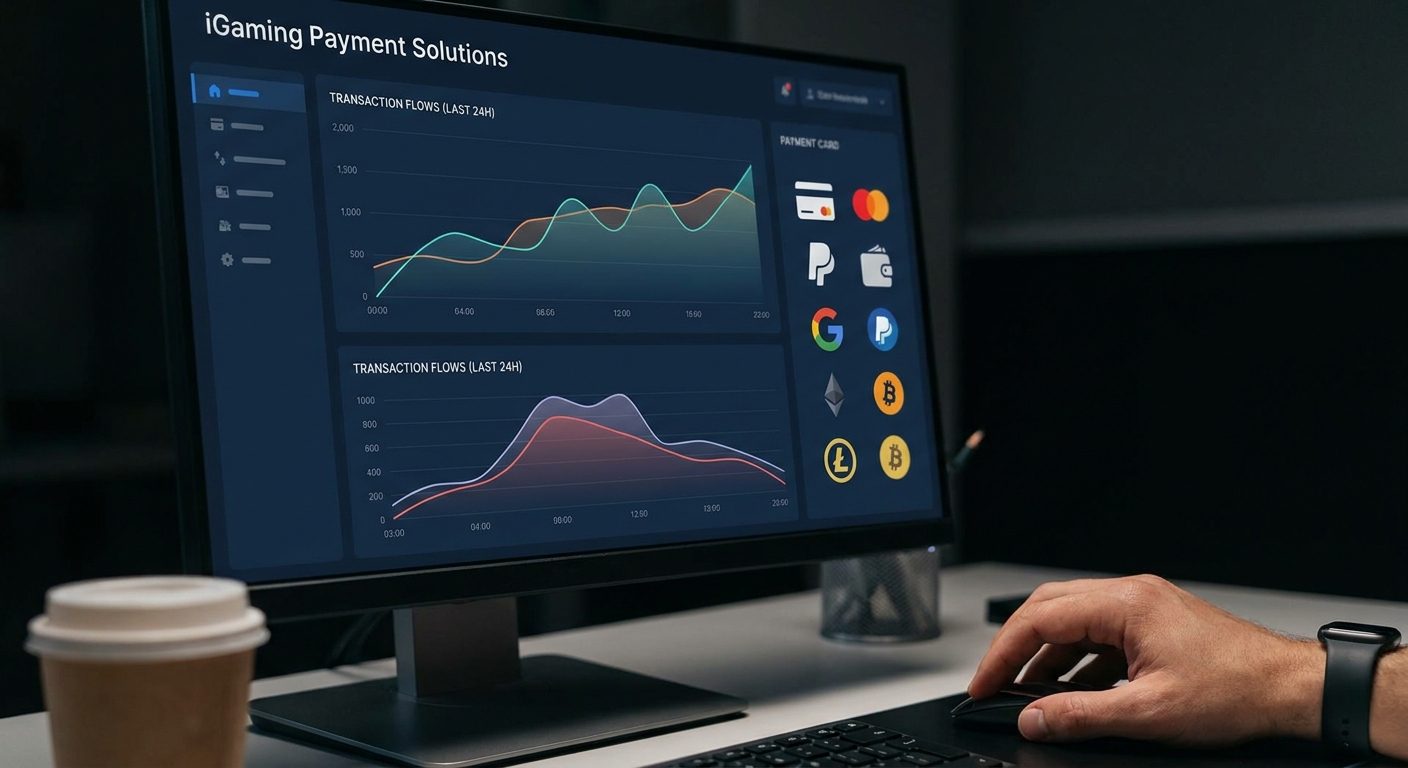

iGaming payment solutions decide more than how money moves. They decide whether an operator can launch in a market, keep a banking relationship, and stay under the chargeback thresholds the card schemes now enforce on the category.
Managing this stack means understanding its components, regulatory demands, and the trade-offs each architectural choice creates. The payment layer sits inside any Gambling Platforms & Software setup, and getting it wrong after launch means a costly rebuild.
Why is iGaming payment processing considered high-risk?
Financial institutions label iGaming high-risk under merchant category code 7995, the classification issuers use for gambling and gaming. That code triggers automatic scrutiny: large transactions, cross-border flows, transient players who attract fraud, and rules that shift by jurisdiction.
- Fraud exposure — bonus abuse, identity theft, and money-laundering attempts push chargeback and fraud-report ratios up before an operator ever sees a stable baseline.
- Chargeback rate — iGaming disputes run well above the 0.5 to 1 percent typical of standard e-commerce, mostly from unrecognized payments and buyer’s remorse, which is why the card schemes apply dedicated monitoring thresholds to the category.
- Authorization swings — approval rates under MCC 7995 tend to sit in the high 80s in mature regulated markets, roughly 85 to 89 percent, and drop to 50 to 70 percent in emerging ones, even with the same processor.
- Cross-border complexity — multiple currencies, local rails, and banking rules that raise the odds of a processing error or a dispute.
This label carries a direct cost: higher fees, rolling reserves that hold back 5 to 10 percent of volume, and account suspensions once risk metrics cross a processor’s threshold. Every one of those costs subtracts from the GGR calculation before an operator sees net revenue.

Core components of iGaming payment solutions
An iGaming payment stack has five interconnected layers, each with a distinct role. Skipping one, or treating them as interchangeable, is how operators end up with payment failures that look like product bugs.
Payment Service Providers (PSPs) and acquiring banks sit at the foundation. PSPs connect a platform to card networks, e-wallets, and local rails; acquiring banks move funds from the player’s issuing bank to the operator’s merchant account and handle chargeback disputes.
- Payment Service Providers (PSPs) — manage the technical connections to banks and payment networks across cards, e-wallets, bank transfers, and local methods.
- Acquiring Banks — process card payments and settle funds from the player’s issuing bank into the operator’s merchant account.
- Payment Gateways — encrypt payment data in transit, acting as the bridge between the platform and the PSP or acquiring bank.
- Fraud Detection Systems — monitor transactions in real time to catch suspicious activity before it becomes a chargeback.
- Payment Orchestration Platforms — route transactions across multiple PSPs to lift approval rates, cut costs, and add redundancy when one processor has an outage.
A white-label setup usually inherits this five-layer stack pre-integrated from the platform provider. That shortcuts the build, but it also ties an operator’s payment terms, reserve requirements, and PSP relationships to whatever the provider already negotiated.

Which compliance rules govern iGaming payments?
Payment compliance for iGaming varies by jurisdiction and changes often. Non-compliance triggers fines, account suspensions, and in serious cases license revocation, consequences that hit revenue before any product issue does.
AML and KYC form the two pillars of payment compliance. AML rules stop gambling platforms from being used to launder money; KYC requires operators to verify identity, age, location, and source of funds for every player before funds move.
- AML Requirements — monitor transactions for suspicious patterns, report unusual activity to the relevant authority, and keep records of financial flows.
- KYC Procedures — collect and authenticate government ID and proof of address, verify age, and confirm the player is inside an authorized territory.
- Source of Funds (SoF) Checks — confirm the legitimate origin of a player’s deposit, required in many jurisdictions once a transaction crosses a set value.
- PCI DSS Compliance — Level 1 requires an annual on-site audit above 6 million card transactions a year across all channels; most iGaming operators sit at Level 2 or 3, where a self-assessment questionnaire applies instead.
Multi-jurisdictional operations make this harder, since each license territory layers its own rules on top. Mature iGaming payment solutions build these checks directly into the transaction flow, rather than routing every verification through a dedicated compliance team.
What chargeback thresholds do the card schemes enforce?
Fraud and chargebacks are not edge cases in iGaming. They are baseline operating conditions that shape how processors price a contract and how large a reserve they hold back.
From April 2026, Visa’s Acquirer Monitoring Program (VAMP) cut the fraud-and-dispute threshold for high-risk merchants from 2.20% to 1.50% across the US, Canada, EU, and APAC; the CEMEA region stays at 2.20%, and Latin America was already at 1.50% before the change.
Mastercard runs a parallel program. Its Excessive Chargeback Program flags an account at 100 chargebacks and 150 basis points in a month, escalating to a High Excessive tier at 300 chargebacks and 300 basis points. Operators that cross either threshold face per-event fines and risk losing card-network access.
| Common iGaming Fraud & Chargeback Challenges | Mitigation Strategies |
|---|---|
| Bonus Abuse & Multi-Accounting Players create multiple accounts or exploit promotional offers for unfair advantage. | Robust KYC, IP address tracking, device fingerprinting, behavioral analytics, and strict bonus terms. |
| Identity Theft & Account Takeover Malicious actors use stolen credentials to access player accounts or make fraudulent deposits. | Multi-factor authentication (MFA), password strength requirements, transaction monitoring for unusual activity. |
| Friendly Fraud (Chargebacks) Legitimate players dispute transactions they made but later regret, or claim not to recognize. | Clear billing descriptors, transaction confirmations, explicit refund policies, 3D Secure authentication, and chargeback alert services. |
| Payment Card Fraud Use of stolen credit/debit card details for deposits. | 3D Secure (3DS) protocols, address verification system (AVS) checks, card verification value (CVV) checks. |
Effective iGaming payment solutions build these defenses into real-time transaction monitoring, risk scoring, and dedicated fraud detection systems. Clear billing descriptors and responsive support cut both fraud losses and the friendly-fraud chargebacks that come from confused players.

What to look for in a payment partner
Picking a payment partner is a strategic decision, and transaction fees are usually the least important variable. The partner’s capabilities shape your compliance burden, market access, and how fast you can launch in a new jurisdiction.
Look for providers that already understand the gambling industry’s demands and integrate as an extension of your compliance and risk management, not as an external vendor bolted on afterward.
- Industry Experience & Compliance Track Record — partners with a proven history navigating iGaming regulation and certification, not payments experience borrowed from another vertical.
- Security Features — encryption, tokenization, and fraud prevention tools such as 3D Secure and AI-driven fraud detection protecting player data and funds.
- Payment Method Diversity & Localization — a wide array of methods for your target markets, including local Alternative Payment Methods (APMs), e-wallets, bank transfers, and compliant crypto options.
- Transaction Speed & Reliability — uptime guarantees, settlement times, and system scalability that hold up during peak load, not just in a sales demo.
- Multi-Currency Support — the ability to handle multiple currencies without excessive conversion fees for global operations.
- Customer Support & Account Management — dedicated assistance for technical issues, disputes, and strategic guidance, not a generic support queue.
This diligence should run alongside any platform provider comparison you are running, since the platform you choose often pre-negotiates, or restricts, which payment partners you can use.
Beyond technical fit, assess ethical standards and licensing posture. Engaging an iGaming compliance team or iGaming advisory team early helps align the payment infrastructure with your business objectives before you sign a processor contract that is hard to unwind.
How to compare iGaming payment providers
Comparing iGaming payment providers means going past headline fees to the criteria that decide whether an iGaming payment solutions stack survives past year one. We put this checklist together because a blended fee quote hides most of what actually breaks at scale.
- Jurisdiction coverage — ask for a market-by-market license list, not a “global coverage” claim. A provider cleared for MGA and UKGC markets does not automatically clear a Curacao or Kahnawake operator.
- Payout speed vs. settlement cycle — these are two different clocks. Player-facing payouts can land in minutes with crypto or e-wallets, or take 1 to 3 business days over ACH; your own settlement into the operator account needs a separate SLA in writing.
- Approval rates by market — request authorization rates segmented by region and card scheme, not one blended figure. MCC 7995 benchmarks tend to sit around 85 to 89 percent in mature regulated markets and 50 to 70 percent in emerging ones.
- Chargeback ratio headroom — confirm how close the provider already runs to Visa’s VAMP threshold (1.50% in most regions) and Mastercard’s Excessive Chargeback Program (100 chargebacks and 150 basis points a month). A provider near the ceiling passes that risk to you.
- Local payment methods on the roadmap — card-only acceptance loses conversion where PIX, UPI, or e-wallets dominate. Confirm which local rails are live today, not “planned,” for each of your target markets.
- Settlement and reserve terms — get the rolling reserve percentage, the holding period, and whether it steps down as your chargeback history matures, all in writing before you sign.
None of these criteria replace direct negotiation. A provider that scores well on paper still needs contract terms that match your projected volume, your markets, and how fast you plan to scale.
What payment trends are shaping the future of iGaming operations?
The iGaming payment landscape keeps shifting as technology, regulation, and player preferences push it forward. None of this is optional anymore. It directly addresses the high-risk processing and fragmented regulation operators face today.
- Payment Orchestration Platforms — more operators route across multiple PSPs at once, using intelligent routing and automated cascading to lift approval rates and add redundancy.
- Localized Alternative Payment Methods (APMs) — conversion in new regions now depends on local rails. PIX in Brazil and UPI in India are examples; a deeper breakdown of these and traditional methods sits in our guide to online casino payment methods.
- Compliant Cryptocurrency Payments — crypto rails settle cross-border transactions in under an hour in many cases, against 1 to 3 business days for ACH, provided the flow stays AML/KYC compliant.
- Open Banking Integration — letting players initiate payments straight from their bank account, promising faster settlement and lower fees, with the most traction so far in European markets.
A resilient iGaming payment solutions stack does not stand alone. It works alongside the platform, game content, and compliance choices that make up the rest of an iGaming launch. If any of those pieces still need a partner, we are glad to talk through where your project stands.
Frequently asked questions about iGaming payment processing
What is a rolling reserve in iGaming payment processing?
A rolling reserve is a percentage of every transaction (typically 5-10%) that the payment processor holds for 90-180 days. It acts as a security buffer against chargebacks, refunds, and fraud losses. The reserve grows for months before reaching steady state, which is why operators routinely see hundreds of thousands of dollars locked up in the first year, a real cash-flow consideration when building runway projections.
Can a single payment service provider handle all global iGaming operations?
No. Different jurisdictions have unique regulations and preferred local payment methods, so a single PSP almost always means lower conversion in at least one market plus single-point-of-failure risk if that PSP suspends the account. Payment orchestration platforms managing multiple PSPs are the standard for any operator running in 3+ jurisdictions.
How do operators balance player experience with strict KYC requirements?
The practical answer is progressive KYC: collect minimum data at signup, layer in more verification as transaction values rise or risk signals trigger. Combined with automated identity verification and smart document capture, this keeps the friction low for the 95% of legitimate players while letting the EDD process kick in only when needed.
What happens when a payment processor suspends an iGaming account?
Immediate operational paralysis: deposits and withdrawals stop, player trust erodes within hours, and regulators often open inquiries when they see the disruption. Reinstatement typically takes weeks to months and requires a full remediation plan demonstrating how the issue that triggered the suspension was structurally fixed.
Which local payment methods matter most in emerging iGaming markets?
The list shifts by region: PIX dominates Brazil, UPI is non-negotiable in India, Interac in Canada, OXXO in Mexico, and various e-wallets across Southeast Asia and Africa. Operators that launch without local rails see conversion drop by 30-50% versus competitors who integrate them; it is usually the single biggest lever for emerging-market growth.
Which chargeback thresholds do Visa and Mastercard apply to iGaming?
Visa and Mastercard each run their own monitoring program, and an operator has to stay under both. From April 2026, Visa’s Acquirer Monitoring Program cut the combined fraud-and-dispute threshold for high-risk merchants from 2.20% to 1.50% across the US, Canada, the EU and APAC, leaving CEMEA at 2.20% and Latin America already at 1.50%. Mastercard’s Excessive Chargeback Program flags an account at 100 chargebacks and 150 basis points in a month and escalates to a High Excessive tier at 300 chargebacks and 300 basis points. Crossing either line brings per-event fines and puts card-network access at risk.