




















For iGaming operators, the cashier is the most critical junction where player intent meets operational reality. Managing online casino payment methods requires a sophisticated balance between reducing friction for the user and maintaining rigorous security protocols to protect the house margin. A single point of failure in the deposit flow can result in immediate abandonment, while a lapse in risk assessment can lead to devastating chargeback ratios in high-volume environments.
Optimizing this stack is not just a matter of adding icons to a website but a strategic technical decision that influences player lifetime value and regulatory standing. Reliable infrastructure is essential for scaling, which is why many industry leaders focus on robust Casino Game Development and integrated payment logic to ensure that the transaction layer remains invisible yet highly reliable during peak traffic periods.

How online casino payment methods directly impact conversion rates
The success of a gambling platform is often measured by the efficiency of its first-time depositor (FTD) pipeline. When players encounter limited online casino payment methods or a cumbersome verification process at the point of purchase, the drop-off rate increases exponentially. High-performance operators treat the cashier experience as a conversion funnel that must be localized to match the specific banking habits of each target jurisdiction.
Localization goes beyond currency symbols; it involves integrating the preferred local rails that users trust and use daily. In markets like Brazil or Scandinavia, failing to offer Pix or Trustly can result in abandonment rates exceeding forty percent. Providing a frictionless deposit experience ensures that the momentum of the player’s initial interest is not lost to technical hurdles or unfamiliar third-party redirections.
To maximize conversion, product managers must analyze the following metrics within their payment architecture:
- Success Rates: The percentage of attempted transactions that are successfully processed without technical errors or bank declines.
- Deposit Velocity: The total time elapsed from the player clicking the deposit button to the funds appearing in their wallet.
- Method Popularity: Tracking which specific payment channels yield the highest retention rates and lowest operational costs for the business.
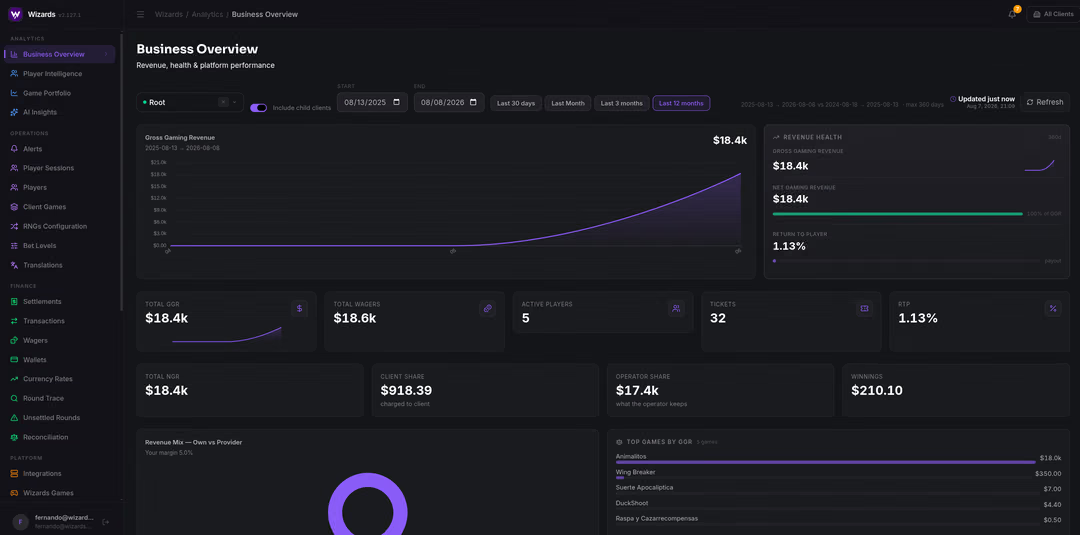
By monitoring these data points, operators can iterate on their payment portfolio to remove underperforming gateways and prioritize those that offer the highest uptime. Seamless integration between the frontend and the payment processor reduces the psychological barrier to entry, directly correlating with higher average revenue per user over time.
Mitigating operational risk through secure payment architecture
Protecting the operator’s margin requires a proactive approach to fraud prevention that does not stifle the user experience. Secure payment architecture must incorporate automated KYC and age verification triggers alongside AML checks that flag suspicious behavior in real time. By utilizing the machine learning models behind modern casino fraud detection, operators can identify patterns associated with bonus abuse or identity theft before a transaction is even finalized, preserving the integrity of the platform’s liquidity.
Chargebacks represent a significant threat to high-risk merchants, often leading to heavy fines or the loss of processing privileges if not managed correctly. Implementing 3D Secure 2.0 and biometric verification provides a dual benefit: it shifts the liability of fraudulent transactions back to the issuing bank and increases player confidence. These technical safeguards act as a shield for the operator’s license, demonstrating a commitment to regulatory standards and financial safety.
Operational risk management also involves setting dynamic limits based on player profiles and historical data. For example, a new user may have lower deposit thresholds until a certain level of trust is established through verified documentation. This tiered approach allows the business to scale safely, ensuring that high-value transactions are scrutinized without delaying the activity of the broader, low-risk player base.
Navigating the compliance landscape for online casino payment methods
Regulatory compliance is the bedrock of a sustainable iGaming business, dictating the scope of available online casino payment methods in any given territory. Operators must adhere to PCI-DSS standards to ensure that sensitive cardholder data is handled with the highest level of encryption. Failure to meet these requirements can result in significant legal liabilities and the potential suspension of payment gateway services by global financial institutions.
Jurisdiction-specific restrictions further complicate the roadmap for international expansion. Some markets, such as the United Kingdom, have implemented strict bans on credit card usage for gambling to promote responsible gaming. Navigating these nuances requires a payment stack that can dynamically adjust available options based on the user’s geo-location, ensuring that the platform remains compliant with local laws without manual intervention from the technical team.
The role of Payment Service Providers (PSPs) is vital during licensing audits, as they provide the necessary reporting and transparency required by gambling commissions. Choosing partners with a proven track record in regulated environments simplifies the auditing process. A compliant payment ecosystem not only prevents legal friction but also serves as a competitive advantage by building long-term institutional trust with banking partners.

The technical trade-off of unified vs multiple gateway integrations
CTOs often face the dilemma of choosing between a unified payment aggregator or maintaining multiple direct gateway integrations. A unified aggregator offers a faster time-to-market and a single API to manage, which is ideal for mid-market operators looking to scale quickly across different regions. However, this approach can introduce a single point of failure and may lead to higher transaction fees due to the intermediary layer.
On the other hand, multiple direct integrations provide greater redundancy and failover capabilities. If one processor experiences downtime or a regional outage, the system can automatically reroute traffic to an alternative provider, ensuring that the cashier remains operational 24/7. This strategy requires a more robust internal engineering team to handle the technical debt of maintaining various APIs and reconciliation processes, but it offers better long-term scalability and cost control.
An API-first approach to the cashier allows for deep customization of the user interface, enabling Product Managers to A/B test different layouts and payment sequences. By decoupling the payment logic from the frontend, operators can swap out providers or update security protocols without disrupting the entire site architecture. This technical flexibility is essential for staying agile in a rapidly evolving technological and regulatory landscape.

Speed as a retention tool and the rise of instant withdrawals
In the modern iGaming market, the speed of payouts has become a primary driver of player loyalty and lifetime value. Instant withdrawals are no longer a luxury but a core product feature that distinguishes top-tier operators from their competitors. When a player knows they can access their winnings immediately, they are more likely to view the platform as a trusted and reliable partner, increasing their propensity to return.
Open Banking and real-time payment rails are revolutionizing how funds move between the casino and the player’s bank account. These systems bypass traditional card networks, reducing transaction costs for the operator and providing near-instant liquidity for the user. Integrating these technologies requires a modern backend capable of handling real-time data synchronization to ensure that account balances are updated accurately across all touchpoints.
For global markets where traditional banking may be slow or restricted, crypto-assets offer a high-speed alternative for both deposits and withdrawals. While cryptocurrencies present unique compliance challenges regarding volatility and source-of-funds verification, they provide a level of liquidity that is unmatched by traditional methods. Operators who successfully integrate these options can tap into a tech-savvy demographic that prioritizes privacy and transactional speed above all else.
Building a resilient and high-converting payment strategy
A successful payment strategy is built on a balanced triangle of conversion, risk mitigation, and regulatory compliance. Focusing too heavily on one aspect can jeopardize the others; for instance, removing all friction might increase fraud, while excessive security could kill conversion. Operators must use a data-driven approach to iterate on their portfolio, constantly analyzing success rates and player feedback to refine the cashier experience.
Selecting the right partners is the final piece of the puzzle. Transparent reporting, high uptime SLAs, and responsive support are non-negotiable requirements for any PSP integration. As the industry continues to evolve, the ability to adapt to new payment trends while maintaining a secure and compliant core will be the hallmark of the most successful iGaming businesses. Investing in high-quality Casino Game Development and a robust payment stack ensures that the operator is prepared for the challenges of tomorrow.
FAQs about online casino payment processing
What are the primary triggers for transitioning from a unified payment aggregator to direct gateway integrations?
Operators typically consider direct integrations when transaction volumes reach a scale where the aggregator’s markup significantly impacts the bottom line. Another trigger is the need for geographic redundancy; if a single aggregator fails, the entire operation halts. Direct relationships with local acquirers often provide better authorization rates and more granular data for risk management. However, this transition requires a robust internal technical team to manage multiple API connections and complex financial reconciliation processes, shifting the burden of maintenance from the vendor to the operator’s development roadmap.
What hidden operational overhead should iGaming businesses expect when expanding their payment portfolio?
Beyond standard processing fees, operators must account for the cost of manual review for flagged transactions and the technical resources required for ongoing API maintenance. Each new jurisdiction may introduce specific reporting requirements that demand custom data exports for regulatory audits. Additionally, currency conversion spreads and settlement delays can impact liquidity management. Successful businesses often invest in automated reconciliation tools to mitigate these indirect costs, ensuring that the complexity of managing multiple local rails does not erode the projected profit margins of the expansion.
How do evolving international regulations influence the long-term technical architecture of a casino cashier?
Regulatory shifts, such as new requirements for source-of-funds checks or mandatory cooling-off periods, require a highly modular cashier architecture. If the payment logic is too tightly coupled with the core platform, implementing these changes can lead to significant downtime or development bottlenecks. Operators should prioritize an API-first approach that allows for dynamic rule triggering based on the player’s jurisdiction. This flexibility ensures that the platform can adapt to sudden legal changes without requiring a complete overhaul of the transaction layer or risking the operator’s licensing status.
How should product managers evaluate if their transaction success rates are meeting industry benchmarks?
Success rates must be analyzed by region and method rather than as a global average. For instance, card authorization rates in emerging markets may naturally be lower than in established European jurisdictions. Product Managers should look for discrepancies between attempted and completed transactions that suggest technical friction or aggressive bank filters. If specific online casino payment methods consistently underperform compared to regional peers, it may indicate outdated protocols or poor routing. Regular auditing of these flows helps identify whether low conversion stems from player behavior or underlying technical inefficiencies.
What is the most effective way to balance aggressive fraud prevention with the need for high conversion?
Finding this balance involves implementing a tiered risk assessment strategy where friction is applied selectively. Low-risk, returning players should experience a streamlined deposit flow, while high-value or new accounts trigger more rigorous verification steps. Using machine learning to analyze behavioral biometrics and device fingerprinting allows operators to identify potential threats without interrupting the experience for legitimate users. This data-driven approach ensures that security measures act as a surgical tool to protect the margin rather than a blunt instrument that drives players toward competitors with smoother processes.
Why do instant withdrawals and Open Banking matter for player retention?
Payout speed has become a primary driver of player loyalty and lifetime value rather than a luxury feature. When a player knows they can access their winnings immediately, they are more likely to view the platform as a trusted partner and to return to it. Open Banking and real-time payment rails move funds between casino and bank account without the traditional card networks, which reduces transaction costs for the operator and shortens the wait for the player. The requirement they impose is a backend capable of real-time data synchronization, so that account balances stay accurate across every touchpoint while the money is in flight.