



















Understanding the financial mechanics of an iGaming operation requires looking beyond the visible turnover to identify the actual sources of profit. While the house edge serves as the core principle for how online casinos make money, true profitability is determined by the operator’s ability to defend margins against significant operational leaks. Stakeholders must distinguish between the statistical advantage of games and the net liquidity that remains after accounting for bonuses, taxes, and platform fees in a highly regulated environment.
To maintain a healthy bottom line, successful operators manage their gaming lobby as a diversified portfolio of financial assets rather than a simple collection of entertainment products. Integrating high-quality content through specialized casino game development services ensures that the mathematical stability of the platform remains intact while optimizing for player retention. This balanced approach allows for predictable revenue streams while mitigating the inherent risks of high-volatility betting cycles.

GGR and the house edge: where the real margin begins
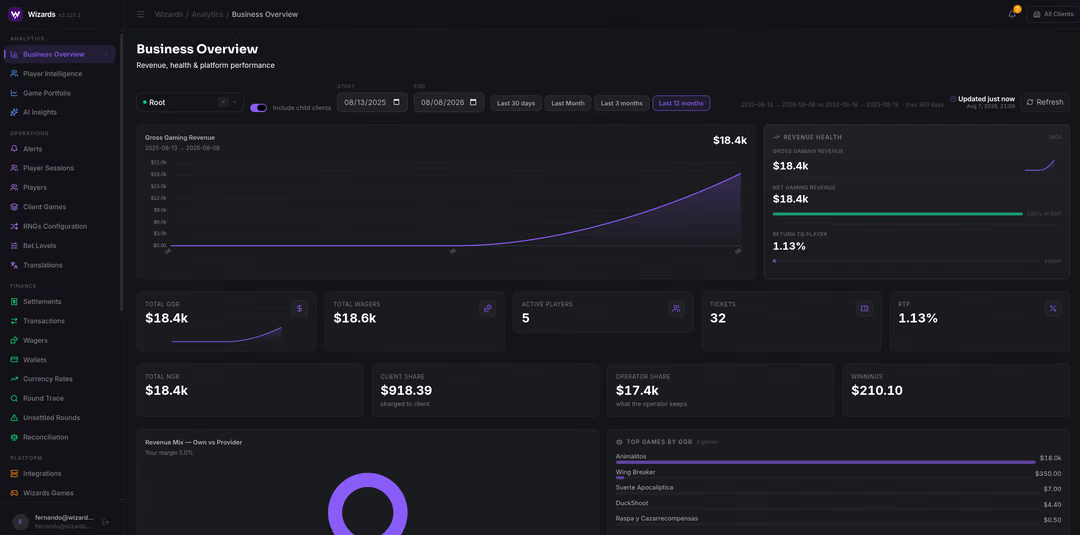
The primary driver of top-line growth in the iGaming sector is the Gross Gaming Revenue, which represents the total volume of wagers minus the total payouts distributed to players. This metric defines the fundamental concept of how online casinos make money by leveraging the mathematical house edge built into every title. Operators must constantly monitor the gap between the theoretical hold and the actual hold to identify performance anomalies that could signal technical issues or fraud; what the GGR figure does and does not include is the first thing to settle before reading that gap.
Theoretical hold is the expected percentage of wagers the house keeps over an infinite number of rounds, whereas the actual hold is the real-time result recorded over a specific period. Discrepancies between these two figures are common in the short term due to the nature of random number generation. For an operator, understanding this variance is essential for financial forecasting and ensuring that the business can sustain periods where players win more than the statistical average.
Volatility also plays a decisive role in short-term cash flow management for smaller and mid-sized casino operators. High-volatility games may offer larger payouts that temporarily deplete operational reserves even if the long-term statistical advantage remains in favor of the house. Balancing the lobby with a mix of low and high volatility games helps smooth out these revenue spikes and ensures more consistent liquidity for daily operations.
From GGR to NGR: The real cost of doing business
Moving from Gross Gaming Revenue to Net Gaming Revenue involves accounting for several critical deductions that often surprise unseasoned operators. Marketing costs in the form of player bonuses and wagering requirements represent a significant portion of these hidden leaks that must be managed carefully. Without strict controls, aggressive acquisition strategies can erode the entire margin of the operation before a single dollar of net profit is realized.
Operational overhead extends beyond marketing to include essential third-party costs that ensure the platform remains functional and competitive. These expenses are often calculated as a percentage of revenue, making them variable costs that scale with the business. Operators must factor in the following recurring expenses to protect their final margins:
- Content Royalties: Fees paid to game providers which typically range from ten to twenty percent of the monthly revenue generated by their titles.
- Processing Fees: Costs associated with payment gateways and the inherent risks of chargebacks which vary significantly depending on the player’s jurisdiction.
- Gaming Taxes: Local levies and license fees that differ based on the regulatory framework of the specific target market and product type.
The transition to Net Gaming Revenue is the true test of an operator’s business viability and strategic planning. By identifying and optimizing each of these cost centers, a Product Manager can transform a high-turnover platform into a high-margin enterprise. Failure to account for these deductions leads to an inaccurate view of profitability that can jeopardize the long-term sustainability of the casino.
Portfolio Strategy: Balancing RTP and Player Lifetime Value
The mix of content in a casino lobby dictates not just who plays, but how long the operator’s capital remains at risk during each session. High Return to Player (RTP) games are often used as tools for player acquisition and retention because they provide more “time on device” for the user. However, these games offer thinner immediate margins for the operator, requiring a high volume of play to be financially effective.
Low RTP games provide a higher immediate margin per wager but risk alienating players if they do not experience frequent enough wins, which is the trade-off the house edge expresses in one number. Finding the right balance is a strategic decision that affects the Lifetime Value (LTV) of the customer base. A well-structured portfolio uses low-margin games to build loyalty and high-margin games to capture the actual profit that sustains the business infrastructure.
High volatility titles also impact bankroll requirements, as the operator must be prepared to cover substantial jackpots at any moment. While these games are popular for their “sticky” nature and ability to drive high engagement, they require a more robust financial cushion. Operators who prioritize retention through balanced RTP strategies often find that they can offset high acquisition costs by extending the duration of the player’s relationship with the brand.

Operational Efficiency as a Margin Protector
Beyond the mathematical edge of the games, the underlying technical infrastructure determines how much revenue is actually retained. Automation in fraud detection is one of the most effective ways to reduce bonus abuse and protect the margin from organized exploitation. By identifying suspicious patterns early, CTOs can prevent significant financial losses that would otherwise be categorized as standard operational costs.
The cost of technical downtime is another critical factor that impacts the bottom line, especially during peak hours or major sporting events. Every minute the platform is offline represents lost revenue that can never be recovered and potentially damages player trust permanently. Investing in high-availability server architecture and redundant systems is not just a technical requirement but a strategic margin protection measure.
Scalable integration processes also contribute to operational efficiency by reducing the time and cost required to add new content or features. Using standardized APIs and modular platform designs allows operators to react quickly to market trends without incurring massive development overhead. Efficiency in this area ensures that the technical debt does not grow alongside the revenue, keeping the operation lean and profitable as it scales.

The impact of regulatory compliance on the bottom line
Compliance is often viewed as a hurdle, but in the modern iGaming landscape, it serves as a primary protector of the long-term margin. The costs associated with technical audits and Random Number Generator (RNG) certifications are essential investments to avoid severe fines and potential license revocations. Proactive compliance software can automate the monitoring process, reducing the need for large manual teams and lowering long-term administrative costs.
Market-specific certifications from reputable labs like GLI or BMM act as barriers to entry that protect established operators from unregulated competition. While the initial investment in these certifications can be high, they provide a level of security that attracts high-value players and institutional partners. Operating in regulated jurisdictions ensures that the business assets are protected by law, which is vital for long-term valuation.
The risk of fines far outweighs the cost of maintaining a robust compliance framework from the beginning of the operation. Successful operators frame compliance as a strategic asset that enhances the brand’s reputation and ensures business continuity. By integrating regulatory requirements into the core product strategy, companies can avoid expensive retroactive fixes and maintain a stable path to profitability.
Optimizing for sustainable iGaming profitability
Protecting margins in the competitive online casino space requires a holistic view of the operation that prioritizes Net Gaming Revenue over vanity metrics like total turnover. Every decision, from game selection to vendor partnerships, should be data-driven and focused on long-term sustainability. Operators who understand the delicate balance between player experience and mathematical edge are the ones who thrive in changing market conditions.
Investing in premium technology and reliable casino game development services is a fundamental step toward lowering operational costs and increasing efficiency. While cheaper solutions may seem attractive initially, they often lead to higher maintenance costs and lower player retention in the long run. Professionalism in technology, combined with a disciplined approach to risk management, remains the most reliable path to achieving and maintaining high margins in the iGaming industry.
FAQs about online casino revenue and profitability
What is the difference between theoretical hold and actual hold?
Theoretical hold is the percentage of wagers the house expects to keep over an infinite number of rounds; actual hold is the real result recorded over a specific period. Short-term discrepancies between the two are normal given the nature of random number generation, which is why the variance has to be understood before it is forecast against — and why a persistent gap is read as a signal of a technical issue or fraud rather than of bad luck.
What is the difference between Gross Gaming Revenue and Net Gaming Revenue?
Gross Gaming Revenue (GGR) is the total amount wagered by players minus the total payouts returned to them. Net Gaming Revenue (NGR) takes GGR and subtracts all operational costs including bonuses, content royalties, payment processing fees, and gaming taxes. NGR is the metric that truly reflects how online casinos make money, as it represents the actual profit available to sustain the business. Operators who focus solely on GGR risk overestimating their financial health by ignoring the significant deductions that reduce the final margin.
How do bonus costs affect the real margins of an online casino?
Bonuses are one of the largest variable costs in an iGaming operation and can erode margins significantly if not managed with discipline. Welcome bonuses, free spins, and wagering incentives are essential for player acquisition, but they directly reduce Net Gaming Revenue. Operators must track the bonus-to-GGR ratio carefully and implement wagering requirements that balance player appeal with financial sustainability. Without strict controls, aggressive promotional strategies can result in the casino spending more on acquisition than it recovers from the player’s lifetime value.
Why does game volatility matter for cash flow management?
Game volatility determines the frequency and size of payouts, directly impacting the operator’s short-term liquidity. High-volatility games can produce large jackpots that temporarily push the realized payout above the theoretical RTP, creating cash flow pressure. Low-volatility games provide steadier, more predictable returns. A balanced portfolio that combines both types allows operators to maintain consistent daily revenue while still offering the high-reward experiences that attract and retain players. This balance is especially critical for smaller operators with limited financial reserves.
What role do content royalties play in the financial structure of an online casino?
Content royalties are fees paid to third-party game providers for the right to host their titles on the casino platform. These fees typically range from ten to twenty percent of the monthly revenue generated by each provider’s games. While premium content from top studios can drive higher player engagement and retention, the associated royalty costs must be factored into the overall margin calculation. Operators often negotiate tiered pricing based on volume or exclusivity to manage these costs while maintaining access to the most popular titles in the market.
How does technical infrastructure directly impact casino profitability?
Technical infrastructure affects profitability in multiple ways beyond simple uptime. Every minute of platform downtime represents lost revenue that cannot be recovered, especially during peak traffic periods. Automated fraud detection systems prevent bonus abuse and protect margins from organized exploitation. Scalable API architectures reduce the cost and time required to integrate new content or payment providers. Operators who invest in reliable, modular technology stacks can adapt faster to market changes while keeping operational costs predictable, directly preserving a larger share of their Net Gaming Revenue.