



















Success in the iGaming sector no longer relies on simply launching more content; it requires a data-driven approach to navigate a saturated market. Understanding the various types of casino games is essential for catering to diverse player demographics, from risk-averse recreational users to high-stakes enthusiasts looking for specific mathematical outcomes. However, operators must balance this variety against technical overhead to avoid a fragmented platform experience that dilutes the user journey.
Achieving this balance demands an alignment between long-term economic goals and the technical robustness of the underlying software. By partnering with a specialized casino game development company, founders and CTOs can ensure that their game selection meets global compliance standards while delivering the innovation needed to drive retention in a competitive landscape.

Categorizing the essential types of casino games for digital operators
High-volume video slots remain the primary driver for most digital platforms due to their scalability and massive appeal across almost every market segment. These games offer the widest variety of themes and mechanics, making them the most effective tool for acquiring a broad user base with relatively low entry barriers. Their technical flexibility allows for rapid updates and localized themes that resonate with specific geographic regions.
- Video Slots: High-volume titles featuring diverse themes and complex bonus mechanics designed to maximize session length and player engagement through variety.
- Table Games: Traditional digital simulations of classics like Blackjack and Roulette that provide the strategic depth and brand credibility veteran players expect.
- Live Dealer: Real-time streamed games that combine the trust of physical casinos with the convenience of digital access, driving high retention rates.
- Specialty Games: Lightweight products such as Keno or Bingo that offer quick rounds and attract niche demographics looking for casual social experiences.
Clarifying these categories from a product perspective allows operators to map their technical complexity against potential player reach. While slots offer the highest volume for the lowest operational overhead, live dealer options require more significant infrastructure but offer unparalleled trust in regulated digital markets. Understanding these trade-offs is the first step toward building a library that maximizes both reach and reliability.
The economic engine of a portfolio through RTP and volatility
Return to Player (RTP) and volatility are the primary financial levers that determine the long-term sustainability and profitability of any gaming portfolio. RTP represents the theoretical percentage of wagered money returned to players, while volatility describes the frequency and size of payouts, directly influencing the operator’s daily cash flow and risk exposure. Balancing these metrics ensures the platform remains attractive to players while protecting the operator’s margin.
A strategic mix often involves low-volatility table games that offer a steady revenue stream and high-volatility progressive slots that provide high-margin potential. This combination ensures that the house can manage its own risk while providing the high-win excitement that drives player lifetime value. Providing a variety of volatility levels allows the platform to satisfy different player psychological profiles within a single ecosystem.
Balancing these metrics requires a portfolio theory approach, where the CTO and CFO align on the expected hold across the entire platform. Over-relying on high-RTP games might increase retention but squeeze margins, whereas too much volatility can frustrate casual players and lead to rapid churn. A carefully calibrated mathematical library is necessary to maintain a healthy balance between user satisfaction and predictable financial performance.
Strategic impact of live dealer and social betting trends
Live dealer games have evolved from a luxury feature to a fundamental trust-building and retention tool for modern digital operators. By bridging the gap between physical and digital experiences, these games offer a level of transparency and social validation that RNG-based simulations cannot match. This makes them indispensable for high-stakes player segments who prioritize the human element and verified fairness in their gaming choices.
Simultaneously, the rise of crash games and social multiplier mechanics is reshaping how platforms attract younger, mobile-first demographics. These games prioritize fast-paced, community-driven outcomes where players can see others’ bets in real-time, leveraging social proof to drive high engagement levels. Capturing this segment requires a shift away from solitary play toward interactive environments that reward quick decision-making and community participation.
The trade-off for these high-engagement categories lies in the operational overhead and development costs compared to standard RNG games. Managing a constant live streaming studio or developing low-latency social mechanics requires significant infrastructure investment and technical expertise. However, the resulting differentiation and higher retention rates often justify the initial capital expenditure for operators looking to stand out from legacy competitors.

Building a balanced roadmap for portfolio diversification
Building a profitable roadmap often starts with a core-satellite model, focusing first on high-performing video slots to establish a reliable revenue base. Once the core is stable, operators can add satellite products like niche table games or innovative social betting mechanics to capture specific market segments. This approach allows for scalable growth without overextending technical resources or compromising the stability of the primary platform.
Decision-makers must constantly evaluate the buy versus build dilemma when expanding their content library. While proprietary development allows for unique branding and higher margins, integrating third-party content through aggregators offers a faster route to market and a broader diversity of mechanics. A hybrid strategy often provides the best results, combining unique flagship titles with a broad library of proven third-party hits.
Throughout this diversification process, mobile-first cross-platform compatibility remains non-negotiable for ensuring the portfolio’s reach across global markets. Ensuring that every game in the library performs seamlessly on low-bandwidth connections and various screen sizes is essential for maximizing ROI. A platform that fails to deliver a consistent experience across devices will struggle to retain users in an increasingly mobile-centric world.

Technical pillars for a scalable and compliant gaming offer
The integrity of a digital gaming offer rests on Random Number Generation (RNG) certification, which serves as the bedrock of market trust and regulatory compliance. Ensuring that every game mechanic is mathematically verified by independent laboratories protects the operator from fraud and legal repercussions. This certification is not just a regulatory hurdle but a critical marketing asset that proves the fairness of the platform to skeptical users.
Modern portfolio management also requires an API-driven architecture that allows for seamless game integration and third-party content aggregation. This technical flexibility enables CTOs to swap out underperforming titles and integrate new trends rapidly, preventing the platform from becoming bogged down by technical debt. A modular architecture ensures that the addition of new game types does not disrupt the performance of existing features.
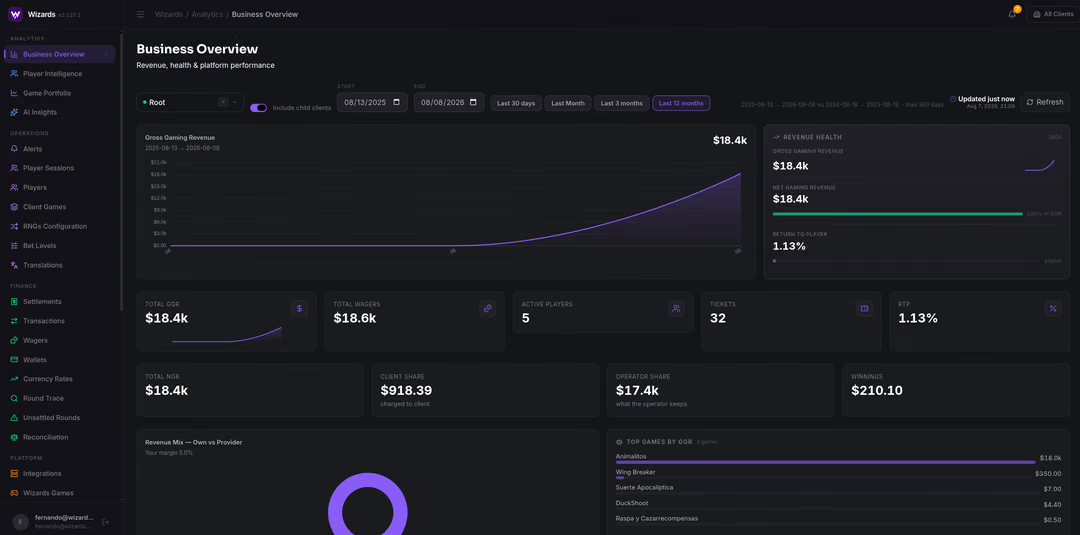
Finally, robust data analytics are required to track performance across different game categories in real-time. By monitoring metrics like Gross Gaming Revenue and drop-off rates at the individual game level, operators can make informed decisions about their library. Real-time data allows for the optimization of the overall profitability of the portfolio by identifying which mechanics resonate best with the current user base.
Maximizing ROI through strategic game selection
Maximizing ROI in the iGaming sector requires a constant balancing act between rapid development speed and long-term player retention. While launching a massive library quickly might seem attractive, a more effective strategy often involves starting with a data-driven MVP that focuses on high-performing categories. This allows operators to validate their market assumptions before committing to the high costs of specialized or custom game development.
Ultimately, the most profitable portfolios are those that combine technical reliability with creative game mechanics that resonate with specific player personas. By choosing a strategic partner like a casino game development company, operators can navigate the complexities of mathematical balancing and global compliance. This strategic approach ensures that profitability is the result of a well-executed plan rather than simple market chance.
FAQs about profitable iGaming portfolio strategies
How should an operator prioritize initial game selection when entering a new digital market?
When entering a new market, operators often struggle between depth and variety. A data-driven approach typically involves launching with a core selection of high-performing video slots to establish baseline revenue. Once the initial user behavior data is analyzed, adding satellite categories like localized table games or crash mechanics helps capture specific player segments. This sequential rollout minimizes initial risk while allowing for technical adjustments based on real-world performance. It ensures the platform remains stable before adding the complexity of live dealer streaming or high-latency social features.
What are the most common pitfalls when balancing a high-RTP gaming library?
While high Return to Player (RTP) percentages are excellent for player acquisition and initial trust, over-relying on them can severely compress an operator’s margins. The challenge lies in finding the equilibrium where retention remains high without sacrificing the long-term sustainability of the platform. Strategic operators often use high-RTP games as promotional tools while balancing the overall portfolio with medium-volatility titles. This approach prevents rapid bankroll depletion for the player while maintaining a healthy house edge that funds ongoing operations and necessary technical infrastructure improvements.
What infrastructure is necessary to support a multi-vendor game aggregation strategy?
Successful multi-vendor strategies depend on a robust, API-first architecture that can handle diverse data formats and varying latency requirements. Before integrating third-party content, technical teams must ensure their backend can aggregate real-time reporting from different providers into a single unified dashboard. This unified data layer is critical for tracking cross-game performance and identifying player drop-off points. Without this infrastructure, operators face significant technical debt and fragmented analytics, making it nearly impossible to optimize the game mix for maximum player lifetime value or identify underperforming titles efficiently.
How does RNG certification impact the long-term scalability of a proprietary game portfolio?
Random Number Generation (RNG) certification is more than a legal requirement; it is a fundamental pillar of platform scalability. Certified games are easier to integrate into regulated markets and third-party aggregators, which significantly expands the potential reach of a proprietary title. From a technical perspective, undergoing rigorous third-party testing ensures that the underlying math models are stable under high load. This prevents costly post-launch bugs or mathematical imbalances that could lead to unexpected financial losses. Maintaining these standards builds institutional trust with both players and B2B partners.
When does it make sense to invest in social betting mechanics over traditional table games?
Investing in social betting mechanics, such as crash games, is often driven by the need to capture younger, mobile-first demographics who find traditional RNG table games too solitary. These mechanics leverage social proof and real-time community interaction, which can lead to higher organic engagement and lower acquisition costs. However, this transition makes sense only when the core platform is technically capable of supporting low-latency environments and real-time data synchronization. Operators should consider these games as high-growth assets that complement, rather than replace, the stable revenue generated by traditional casino categories.
What is the core-satellite model for a casino game portfolio?
It builds the library in two stages. The core is a set of high-performing video slots that establishes a reliable revenue base and proves the platform under real traffic. The satellites are added afterwards — niche table games, innovative social betting mechanics, localized titles — each one aimed at a specific market segment rather than at general coverage. Sequencing it this way allows for scalable growth without overextending technical resources or putting the stability of the primary platform at risk, which is the failure mode of launching a large library all at once.