















Artificial intelligence is being used across many industries, and game development is one of them. This piece covers the fundamentals: which types of AI developers actually use, where in production they use them, the tools and languages involved, and what the technology is and is not good for.
If you have read our piece on the role of AI in game development, this is the practical companion to it.
Which types of AI game developers use
Game developers use AI as several technologies rather than one, each doing a different job inside a game project. The table below lists the types most often involved in the development process.
| AI Type | Description |
| Pathfinding AI | Determines optimal paths for NPCs to navigate the game world, avoiding obstacles. |
| Decision-making AI | Enables NPCs to make intelligent decisions based on predefined rules or learned behavior. |
| Learning AI | Learns and adapts over time, improving performance through machine learning and neural networks. |
| Reactive AI | NPCs that react to player actions or environmental changes in real-time. |
| Fuzzy Logic AI | Utilizes fuzzy logic to make decisions based on imprecise or uncertain inputs. |
| Genetic Algorithms | Uses genetic programming principles to evolve and optimize behavior. |
| Swarm AI | Models the behavior of swarms or groups of entities, such as flocking behavior. |
| Natural Language Processing | Allows for interactive dialogues and understanding of player input in natural language form. |
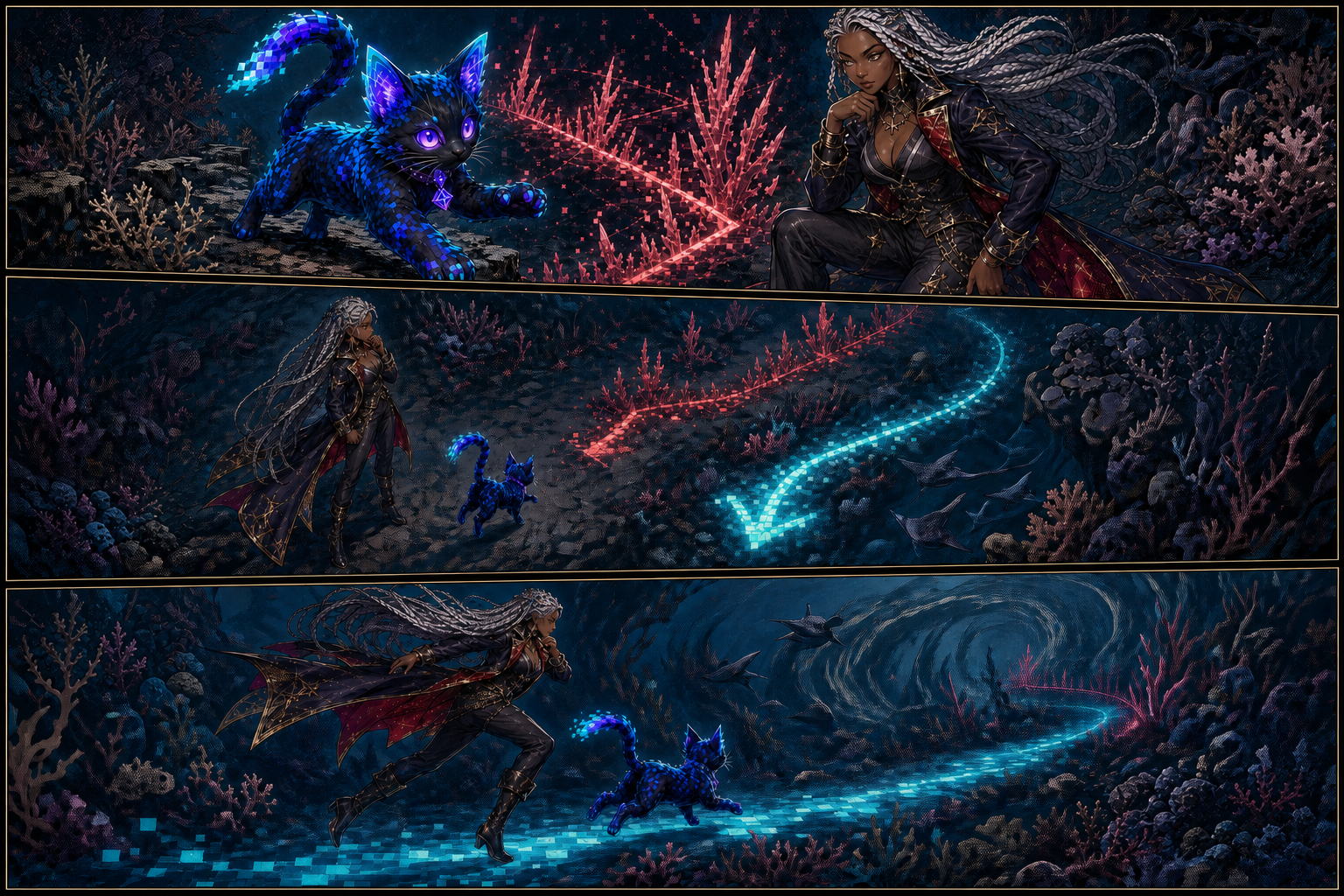
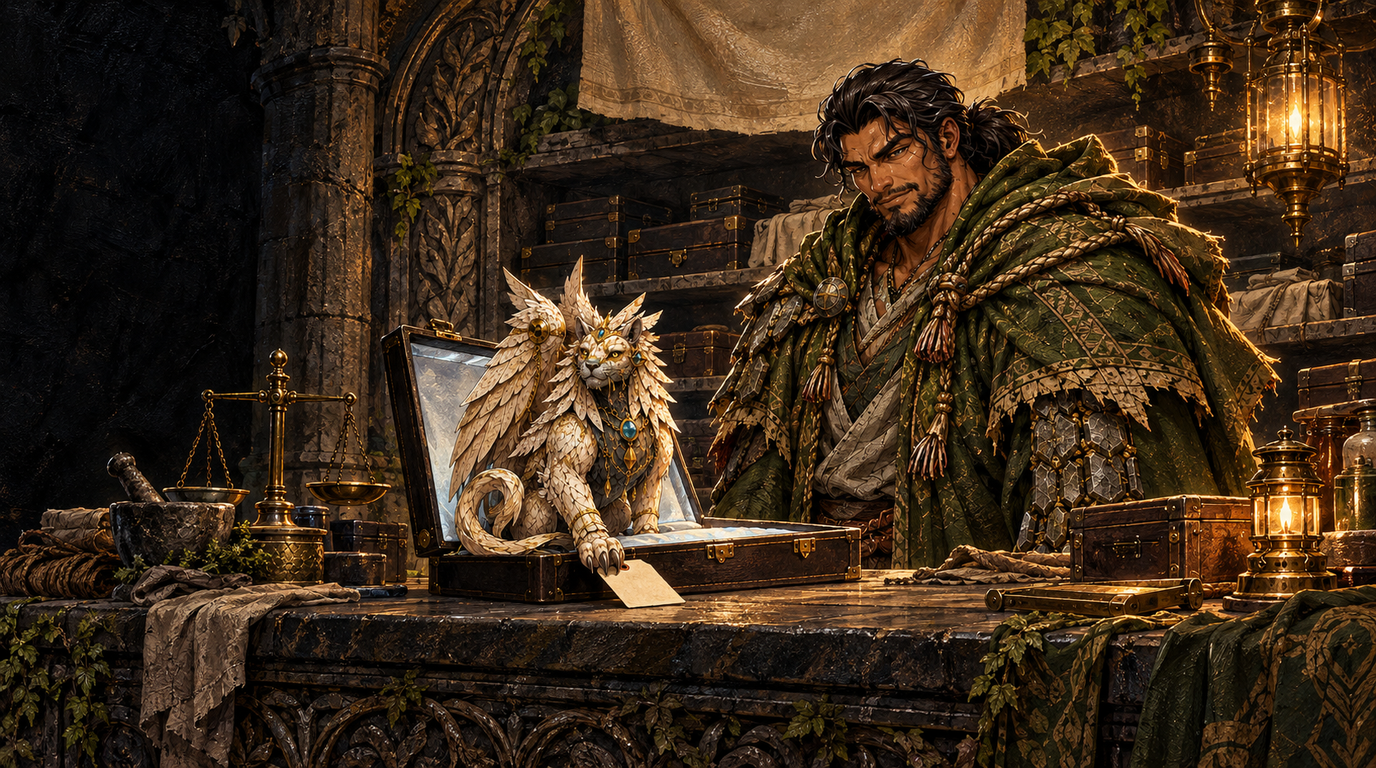
Voidsail CaptainWhat do you sense?
Pixel Sprite CatA blocked route.
Voidsail CaptainThen choose.
Pixel Sprite CatThe safer path.
Voidsail CaptainNow act.
Pixel Sprite CatAnd sense again.
Where AI is already used in game development
AI turns up in five development areas that a player would not group together — story, characters, world generation, animation and sound. The field keeps moving, so naming every use is close to impossible; these are the ones with the clearest effect on what reaches the player.
Storytelling
AI can alter storylines and dialogue in response to player choices, which is what makes a personalised playthrough possible. Responding in real time to decisions is how a game produces a story that is not the same one twice.
NPC behaviour
AI lets NPCs learn from players, which makes them harder to predict. Characters that evolve rather than repeat add replay value and depth.
Procedural generation
Procedural generation creates content algorithmically instead of by hand, so landscapes, levels and items vary without manual effort. AI algorithms can design environments and objects that are both unique and coherent, which is what makes exploration worth doing.
Animation
AI produces character movement that follows the game’s physics. Motion capture and machine learning together give animations that adapt to the game’s dynamics and to player actions.
Sound design
AI can generate music and sound that match what is happening in play. Sound that changes with the player’s actions is what carries the emotional weight of a scene.
The basic AI tools for game development
Several AI tools are already in general use, and some are free. The field keeps evolving, so the table below is a starting set rather than a complete one.
| AI Tool | Description |
| Scenario.com | A free AI-powered tool that creates game assets from characters to sounds. It helps create game stories and scenarios using natural language. |
| Prometheanai | An AI-powered platform designed for developing immersive VR and AR games. It assists in producing realistic and dynamic environments, objects, and effects. |
| Plask & RadicalMotion | AI tools that generate character animations using motion capture and deep learning. They also help craft facial expressions and lip-syncing. All of these are through computer vision and natural language processing. |
| Ludo.ai | An AI tool designed to create adaptive NPCs. It uses reinforcement learning and behavior trees. It also helps NPCs talk with natural language generation and voice tools. |
| DreamTextures and Stable Diffusion | These AI tools improve game graphics and sound quality. They use neural networks and deep learning. They also perform image and video processing tasks like upscaling, denoising, and super-resolution. |
AI for game art and design
AI tools have changed game art by speeding up creation and raising quality, and their reach runs from logo creation to background audio generation. What they do not replace is a design team deciding what the game should look like in the first place.
Choosing a language and framework for AI in game programming
The language and framework decide what kind of AI is practical to build, so the choice comes before the tooling. The table sets out the common pairings and what each is good for.
| Programming Language | Framework | Advantages |
| Python | Pygame | Simplicity |
| Ease of use | ||
| Quick prototyping | ||
| C++ | Unreal Engine | Ideal for High-performance needs |
| Robust AI capabilities | ||
| Industry-standard for AAA games | ||
| Lua | CryEngine | Speed |
| Lightweight | ||
| Suitable for real-time systems | ||
| Java | LibGDX | Complex AI systems |
| Cross-platform development | ||
| Rich ecosystem | ||
| C# | Unity | Good balance between ease and capability |
| Large community support | ||
| Extensive features for AI development | ||
| JavaScript | Phaser | Web-based game development |
| Browser compatibility | ||
| Rapid development | ||
| Python/C++ | TensorFlow | Machine learning capabilities |
| Advanced game analytics | ||
| Customizable and scalable solutions for AI in games |
Which pairing is right depends on the project’s needs and goals rather than on which is most capable in the abstract.
AI coding assistants
AI coding assistants suggest, complete and analyse code as a developer writes it, which is a different use of AI from anything the player sees. Whether they can go further than that — writing a program on their own — is a question we looked at separately in can AI write its own code.
| AI Coding Assistant | Description |
| Tabnine | An AI-powered code completion tool that offers intelligent suggestions as you type. It supports many languages and predicts the next line of code to enhance efficiency. |
| Codium AI | An AI-based coding assistant that provides real-time code analysis and suggestions. It’s designed to help developers write cleaner and more efficient code. |
| Mutable AI | Uses machine learning to assist developers in writing and refactoring code. It offers context-aware suggestions and can help optimize code for performance and readability. |
| Sourcegraph | An AI-powered code search and navigation tool. It’s used by developers to explore and understand codebases more effectively. It offers intelligent code suggestions and insights to improve code comprehension and productivity. |
| GitHub Copilot | An AI pair programmer developed by GitHub in collaboration with OpenAI. It provides code suggestions and completions based on the context. This makes it easier for developers to write code and learn new programming patterns. |
AI for game testing and optimisation
AI has changed game testing by simulating large numbers of scenarios and finding issues that traditional methods can miss. From stress tests to analytics, it is used to check that a game performs before players find out that it does not.
Predictive analytics and customisable frameworks make testing more targeted, and Test AI, Functionize and Appsurify are among the tools doing it.
Where AI in gaming is heading
The near-term promise of AI in gaming is immersion and variety rather than autonomy. Environments that adapt fluidly to players, AI entities whose interactions are harder to distinguish from human ones, music composed dynamically to match a scene, and natural language processing that supports real conversation are the directions the technology is pointed in.
Building a game takes design, programming and a clear reading of what the project needs, and choosing among the tools above is part of that. If you are planning one, talk to us and we will work through the options with you.
Frequently asked questions
Do game developers use AI?
Yes. Several types are involved in the development process, including pathfinding AI for navigation, decision-making AI for NPC choices, learning AI that improves through machine learning and neural networks, reactive AI, fuzzy logic AI, genetic algorithms, swarm AI and natural language processing for dialogue.
What is the difference between real-world AI and game-development AI?
Game AI focuses on the action an entity should take in response to current conditions, usually by controlling intelligent agents such as characters, vehicles or groups, in a Sense/Think/Act cycle: sense environmental factors, decide from the sensed data, execute the action. Real-world AI emphasises the sense part, using machine learning to interpret real-world data and extract semantic information, and is often framed as a classification problem.
Which programming languages and frameworks are used for AI in games?
Python with Pygame for simplicity and quick prototyping; C++ with Unreal Engine where high performance and robust AI are needed, which is the AAA standard; Lua with CryEngine for lightweight real-time systems; Java with LibGDX for complex AI and cross-platform work; C# with Unity for a balance of ease and capability; JavaScript with Phaser for browser games; and Python or C++ with TensorFlow for machine learning and game analytics.
Are there any ethical concerns about AI in gaming?
Yes. The strongest concern about AI tools is whether they can replace certain kinds of jobs, which in the gaming industry means developers. In principle those jobs are not in danger, but many countries have advanced bills to address concerns of this kind and there is still a long way to go.
Can AI improve game design and storytelling?
AI is already improving game design: the tools have sped up creation and raised the quality and variety of game content. In storytelling, AI can alter storylines and dialogue based on player choices, which is what makes personalised experiences and branching narratives possible.
How does AI affect game difficulty and balancing?
AI adjusts difficulty dynamically to a player’s skill and choices, adapting challenges and helping in real time through algorithms that read how the player is doing rather than a fixed difficulty setting.